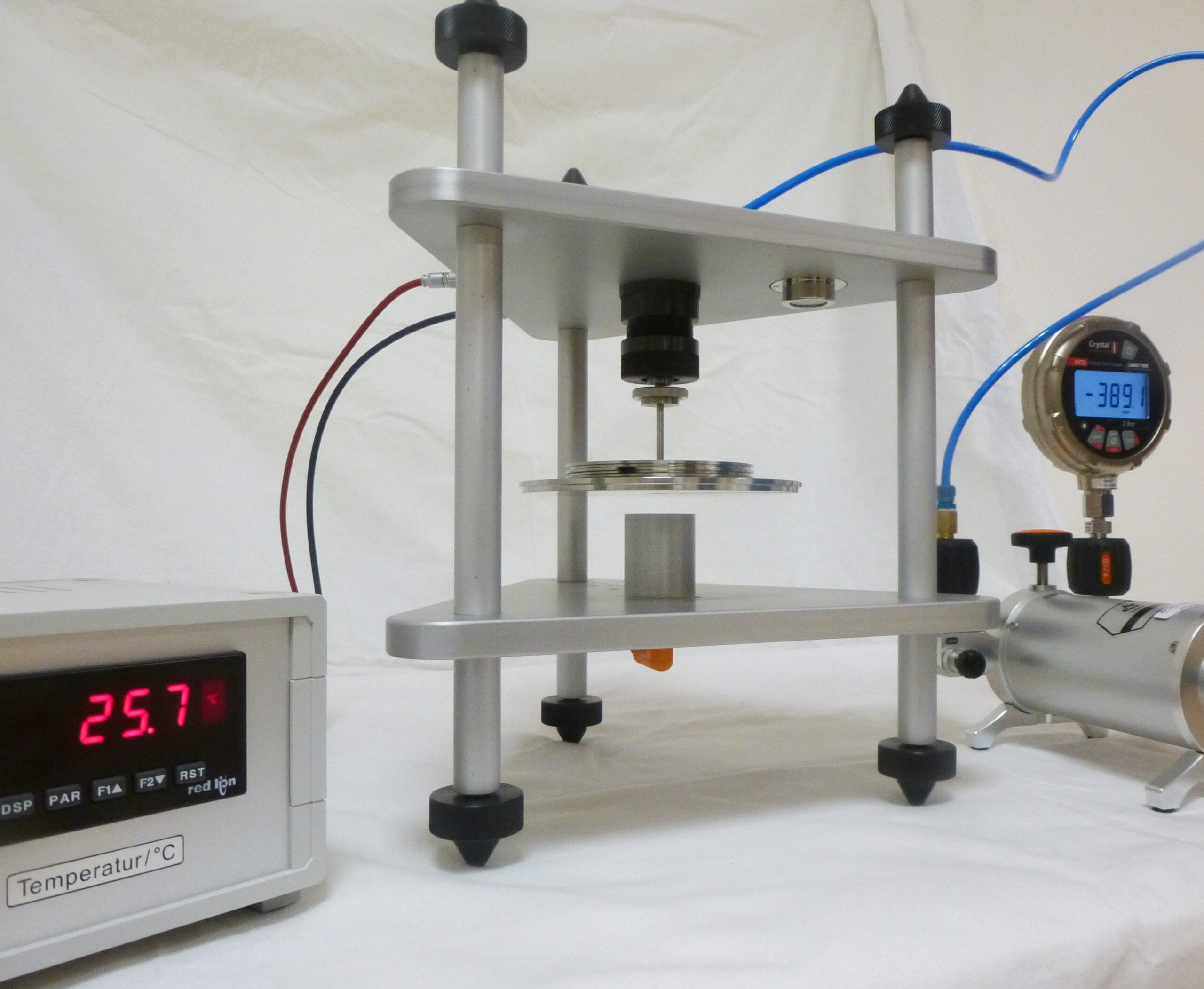
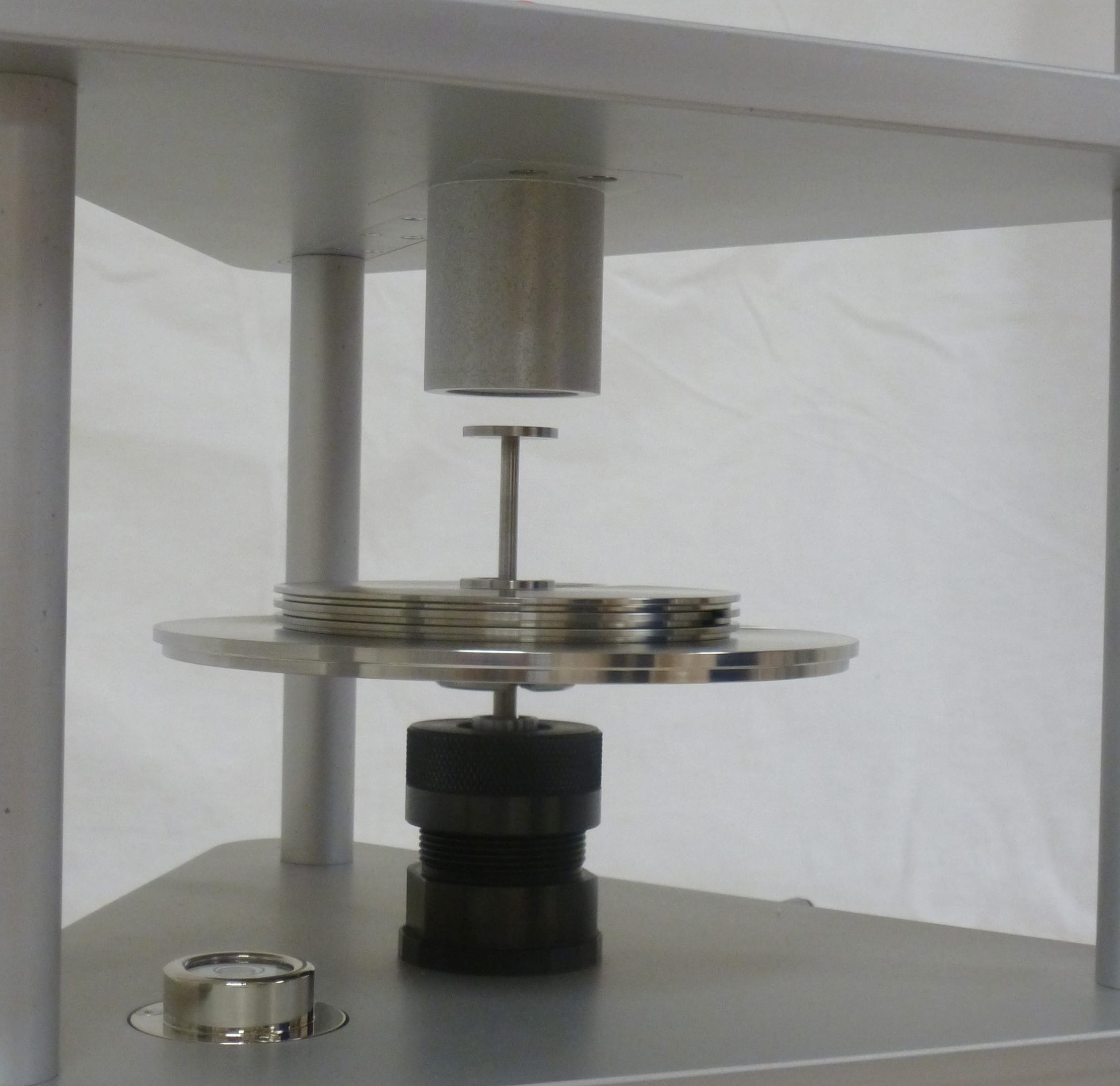
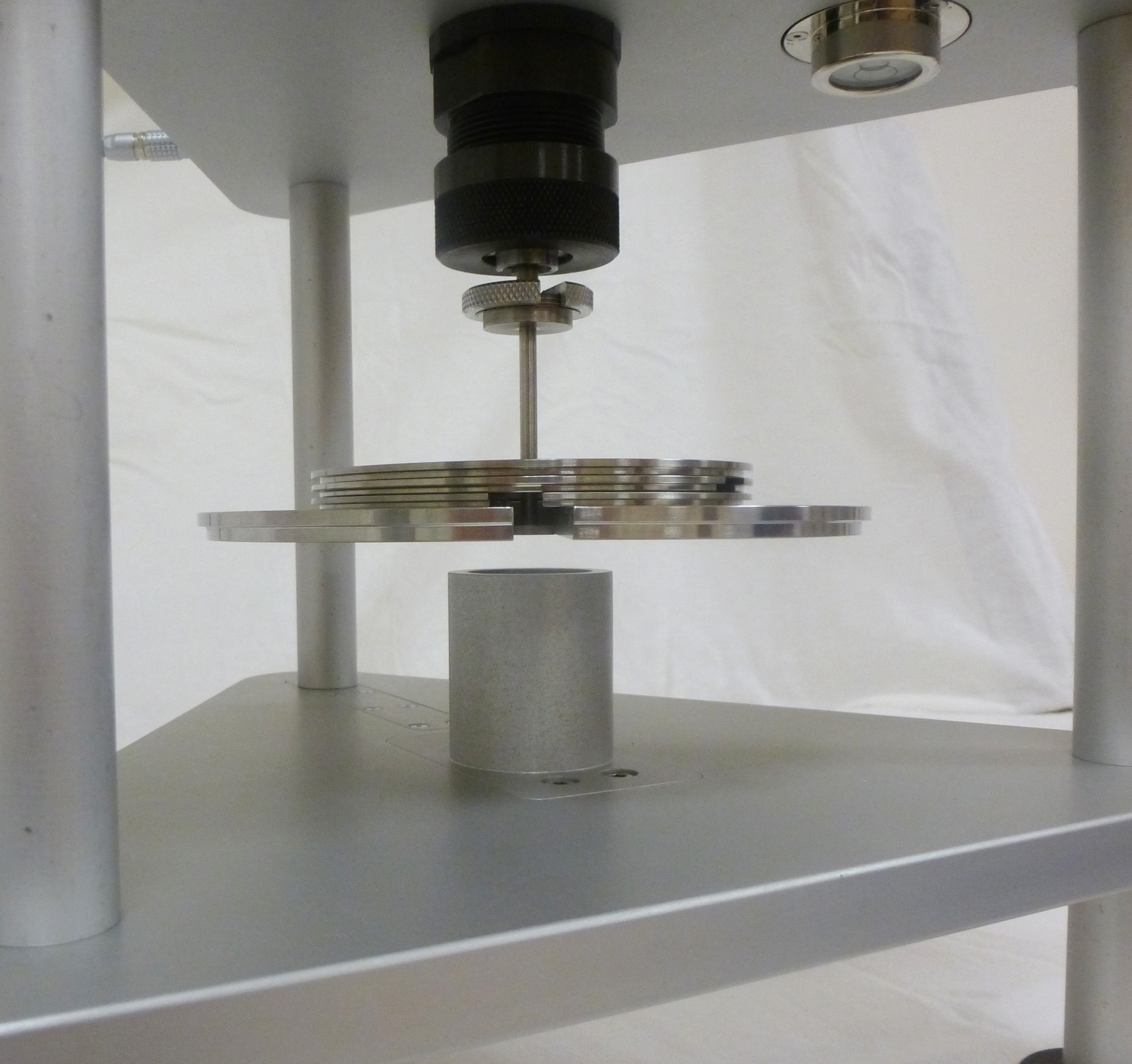
europascal EP-BG100k is a precision piston gauge for generating and measuring bidirectional pneumatic pressure. Designed for operation with both positive and negative gauge pressure, the system covers a pressure range from −100 kPa to +100 kPa and uses air as the pressure medium. This makes the EP-BG100k particularly suitable for professional calibration laboratories requiring an accurate physical pressure reference around atmospheric pressure.
Unlike conventional piston gauges designed exclusively for positive pressure, the europascal EP-BG100k enables both positive and negative gauge pressure to be generated with one system. This bidirectional capability is especially useful for calibration of differential pressure instruments, low-pressure gauges, pressure transmitters, sensors and other devices operating around atmospheric pressure.
The fundamental operating principle of the piston gauge is based on the relationship between force and effective piston area. Precisely characterized masses generate a defined force on the piston-cylinder assembly. The resulting pressure can be calculated from the applied force and effective piston area while taking the relevant correction quantities into account.
As a result, the EP-BG100k provides a pressure reference based on fundamental physical quantities and is particularly suitable for demanding pressure metrology.
At europascal, we provide complete solutions for professional pressure calibration. In addition to piston gauges and deadweight testers, our portfolio includes pressure controllers, pressure calibrators, digital pressure gauges, pressure generators and accessories.
For regular calibration and metrological traceability of pressure standards and measuring instruments, use the europascal Calibration Service.
Your Benefits at a Glance
- Precision piston gauge for bidirectional pressure
- Positive and negative gauge pressure generation
- Pressure range from −100 kPa to +100 kPa
- Pneumatic operating principle
- Air as the pressure medium
- Physical pressure reference based on force and area
- Suitable for pressure calibration around atmospheric pressure
- One system for positive and negative pressure
- Suitable for differential pressure applications
- Suitable for pressure gauges
- Suitable for digital pressure gauges
- Suitable for pressure transmitters
- Suitable for pressure transducers
- Suitable for pressure sensors
- Suitable for low-pressure measuring instruments
- Excellent solution for calibration laboratories
- Designed for professional pressure metrology
- Supports traceable calibration workflows
- Suitable for research and development
- Suitable for quality assurance
Ideal for Demanding Calibration Applications
The europascal EP-BG100k was developed for pressure calibration applications where both positive and negative gauge pressure must be generated accurately.
Many pressure instruments operate around atmospheric pressure. Depending on their application, these instruments may measure positive gauge pressure, negative gauge pressure or both directions.
Using separate systems for positive and negative pressure can make calibration more complicated.
The bidirectional design of the EP-BG100k provides an efficient solution by covering both pressure directions with one piston gauge.
Typical applications include:
- Accredited calibration laboratories
- Factory calibration laboratories
- Quality assurance
- Pressure instrument manufacturing
- Research and development
- Environmental measurement
- Process measurement
- HVAC applications
- Differential pressure measurement
- Low-pressure calibration
- Sensor development
- Production testing
The EP-BG100k is therefore particularly useful wherever precise pressure generation close to atmospheric pressure is required.
Bidirectional Pressure from −100 kPa to +100 kPa
The europascal EP-BG100k provides a bidirectional pressure range from:
−100 kPa to +100 kPa
This corresponds to approximately:
−1 bar to +1 bar
relative to atmospheric pressure.
The negative portion of the range enables vacuum or negative gauge pressure calibration, while the positive portion provides controlled gauge pressure above atmospheric pressure.
This combination allows instruments with bipolar or bidirectional measuring ranges to be calibrated without changing to a fundamentally different pressure reference system.
What Does Bidirectional Pressure Mean?
Bidirectional pressure measurement means that pressure can be measured or generated on both sides of the atmospheric reference point.
At 0 kPa gauge pressure, the system pressure corresponds to the atmospheric reference pressure.
Positive gauge pressure means that the applied pressure is higher than atmospheric pressure.
Negative gauge pressure means that the applied pressure is lower than atmospheric pressure.
The europascal EP-BG100k is designed specifically for this type of operation.
Its pressure range extends from negative gauge pressure through zero to positive gauge pressure.
This makes the system particularly useful for devices that naturally operate around atmospheric pressure.
Piston Gauge Measurement Principle
The europascal EP-BG100k uses the proven piston gauge principle.
The basic relationship is:
p = F / A
where:
p = pressure
F = force acting on the piston
A = effective piston area
A precisely defined force acts on a characterized piston-cylinder assembly.
The resulting pressure can be determined from the applied force and effective area.
For high-accuracy measurements, additional influence quantities can be considered according to the required measurement model and calibration procedure.
These may include:
- Local gravitational acceleration
- Air buoyancy
- Temperature
- Effective piston area
- Atmospheric pressure
- Deformation effects
- Pressure head corrections
This physically based measurement principle is one of the major advantages of piston gauges in professional pressure metrology.
Pneumatic Operation with Air
The europascal EP-BG100k operates pneumatically and uses:
Air
as the pressure medium.
Pneumatic operation is particularly appropriate for the relatively low pressure range covered by the EP-BG100k.
Unlike hydraulic pressure balances, no oil is required in the measurement circuit.
This can be advantageous when calibrating pressure instruments that are designed for clean pneumatic operation or must not be contaminated with hydraulic fluids.
The use of air also makes the system suitable for many sensitive low-pressure devices.
Calibration Around Atmospheric Pressure
Pressure calibration around atmospheric pressure requires particular attention because the system must transition between negative and positive gauge pressure.
The europascal EP-BG100k is designed specifically for this measurement task.
A typical calibration sequence can include points such as:
- Negative full-scale pressure
- Intermediate negative pressure
- Zero pressure
- Intermediate positive pressure
- Positive full-scale pressure
Additional points can be selected according to the device under test and applicable calibration procedure.
This allows the complete characteristic of a bidirectional pressure instrument to be evaluated.
Calibration of Differential Pressure Instruments
Differential pressure instruments are widely used in industrial and laboratory applications.
Typical applications include:
- Filter monitoring
- Cleanroom monitoring
- HVAC systems
- Airflow measurement
- Ventilation systems
- Process control
- Leak testing
- Environmental monitoring
Many of these instruments operate at relatively low pressures and may require calibration on both sides of zero.
The europascal EP-BG100k provides a suitable reference principle for these applications.
Calibration of Pressure Gauges
The EP-BG100k can be used for calibration of suitable mechanical and digital pressure gauges within its pressure range.
The device under test is exposed to defined pressure values generated by the piston gauge.
Its indication is then compared with the calculated reference pressure.
A calibration can be performed at several increasing and decreasing pressure points.
Depending on the calibration procedure, this allows characteristics such as indication deviation, repeatability and hysteresis to be evaluated.
Calibration of Pressure Transmitters
Pressure transmitters can also be calibrated using the europascal EP-BG100k as the pneumatic pressure reference.
The transmitter is exposed to defined reference pressures while its electrical output is measured using suitable electrical measurement equipment.
Typical transmitter signals include:
- 4–20 mA
- Voltage
- Digital output signals
For bidirectional transmitters, calibration points can be generated below and above atmospheric pressure.
This enables the complete pressure measurement range of the transmitter to be evaluated.
Pressure Sensor Calibration
Modern pressure sensors are used in a wide variety of applications ranging from industrial automation to research.
The europascal EP-BG100k provides a physical reference for suitable sensors operating within the bidirectional pressure range.
Depending on the sensor design, an appropriate readout, digital multimeter, calibrator or data acquisition system can be used to measure the electrical output.
The piston gauge provides the reference pressure against which the sensor output is evaluated.
Advantages of a Physical Pressure Reference
Electronic reference pressure gauges provide convenient pressure measurements, but piston gauges offer a fundamentally different metrological approach.
The pressure generated by a piston gauge is derived from physical quantities including force and effective piston area.
This provides several advantages for demanding metrology applications.
A well-characterized piston gauge can provide:
- Excellent long-term stability
- High repeatability
- A physically defined pressure reference
- Traceable pressure generation
- Low dependence on electronic sensor drift
- Excellent suitability as a laboratory reference standard
These characteristics make piston gauges valuable instruments for maintaining pressure traceability.
Importance of Local Gravity
The force generated by a calibrated mass depends on gravitational acceleration.
For high-accuracy piston gauge measurements, the local gravitational acceleration at the installation location can therefore be an important influence quantity.
Standard gravity is defined as:
9.80665 m/s²
However, the actual local value varies depending on geographic location and elevation.
When required by the measurement uncertainty, the local gravity value can be included in the calculation of the generated pressure.
This is especially relevant when a piston gauge is used as a high-level reference standard.
Environmental Influences
Environmental conditions can affect high-accuracy pressure measurements.
Relevant quantities can include:
- Ambient temperature
- Atmospheric pressure
- Relative humidity
- Local gravity
- Air density
- Piston-cylinder temperature
The significance of each contribution depends on the required accuracy and measurement uncertainty.
For professional calibration applications, these influence quantities should be considered according to the applicable measurement model and laboratory procedure.
Applications in Calibration Laboratories
The europascal EP-BG100k is particularly suitable for professional pressure laboratories requiring an accurate reference around atmospheric pressure.
Its bidirectional capability allows one system to cover negative and positive gauge pressure.
This can simplify calibration workflows and reduce the need to change between separate pressure reference systems.
Typical users include:
- DAkkS-accredited calibration laboratories
- ISO/IEC 17025 calibration laboratories
- National and industrial metrology laboratories
- Factory calibration departments
- Pressure instrument manufacturers
- Research institutes
- Quality assurance departments
- Service organizations
Technical Highlights
The europascal EP-BG100k combines bidirectional operation with the proven piston gauge measurement principle:
- Bidirectional pneumatic piston gauge
- Pressure range from −100 kPa to +100 kPa
- Approximately −1 bar to +1 bar gauge pressure
- Positive and negative pressure generation
- Air as pressure medium
- Physical pressure generation based on force and area
- Suitable for calibration around atmospheric pressure
- Suitable for differential pressure applications
- Suitable for low-pressure instruments
- Suitable for pressure gauges
- Suitable for transmitters
- Suitable for sensors
- Professional laboratory reference
- Designed for pressure metrology
- Suitable for traceable calibration procedures
Technical Specifications
| Feature | europascal EP-BG100k |
|---|---|
| Manufacturer | europascal |
| Model | EP-BG100k |
| Device type | Bidirectional Piston Gauge |
| Pressure range | −100 kPa to +100 kPa |
| Approximate range in bar | −1 bar to +1 bar |
| Pressure mode | Positive and negative gauge pressure |
| Pressure medium | Air |
| Operating principle | Piston gauge |
| Reference principle | Force / effective piston area |
| Typical applications | Low and bidirectional pressure calibration |
| Suitable for | Gauges, transmitters, transducers and sensors |
| Application area | Professional pressure metrology |
Pressure Calibration at europascal
In addition to providing high-quality pressure calibration equipment, europascal operates specialized calibration laboratories for pressure and other measurement quantities.
The europascal pressure laboratory covers an exceptionally wide range of pressure measurement applications, from very low pressures to ultra-high pressure.
This experience enables europascal to support customers not only in selecting a suitable piston gauge but also in developing complete calibration solutions.
Depending on the application, europascal can assist with:
- Selection of reference standards
- Pressure generation
- Adapters and connections
- Calibration procedures
- Measurement uncertainty
- Metrological traceability
- Maintenance and repair
- Calibration of pressure equipment
For professional calibration services, visit the europascal Calibration Service.
Why Choose the europascal EP-BG100k?
The europascal EP-BG100k provides a specialized solution for precise pneumatic pressure generation on both sides of atmospheric pressure.
Its bidirectional range from −100 kPa to +100 kPa allows negative gauge pressure, zero pressure and positive gauge pressure to be covered with one reference system.
This makes the EP-BG100k particularly useful for calibration of pressure instruments that operate around atmospheric pressure.
The pneumatic operating principle uses air as the pressure medium, avoiding contamination of sensitive devices under test with hydraulic fluids.
At the same time, the piston gauge principle provides a physical pressure reference based on force and effective piston area.
For professional calibration laboratories, pressure instrument manufacturers and research facilities, the EP-BG100k therefore provides an effective solution for bidirectional pressure metrology.
At europascal, we can assist you in integrating the EP-BG100k into your calibration laboratory and selecting the appropriate pressure connections, accessories and supporting measurement equipment.
For professional calibration and metrological traceability of piston gauges, pressure gauges, transmitters and pressure sensors, use the europascal Calibration Service.
Discover more pressure calibration products from europascal.
Manufacturer information about the europascal EP-BG100k is available directly from europascal.