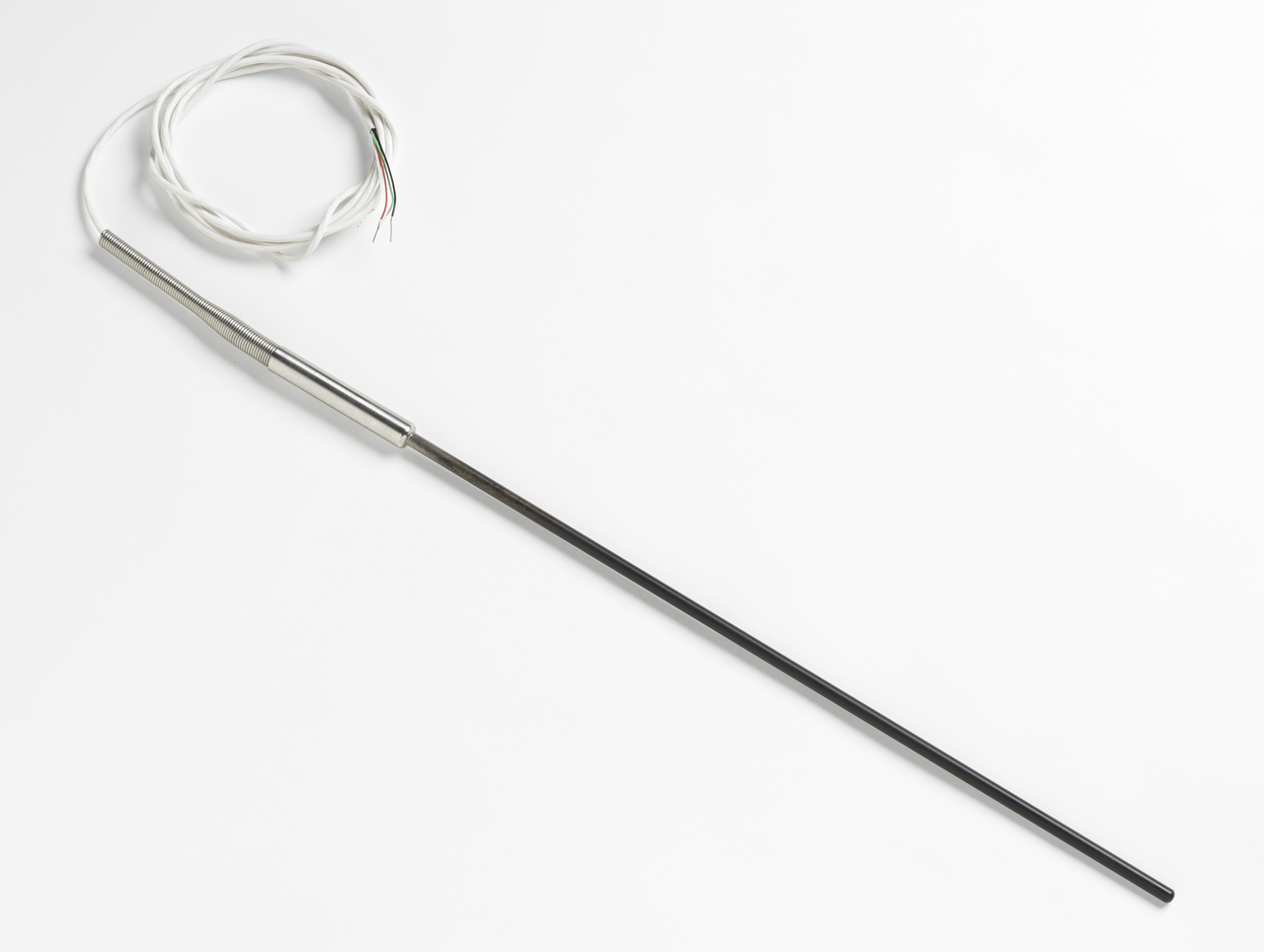
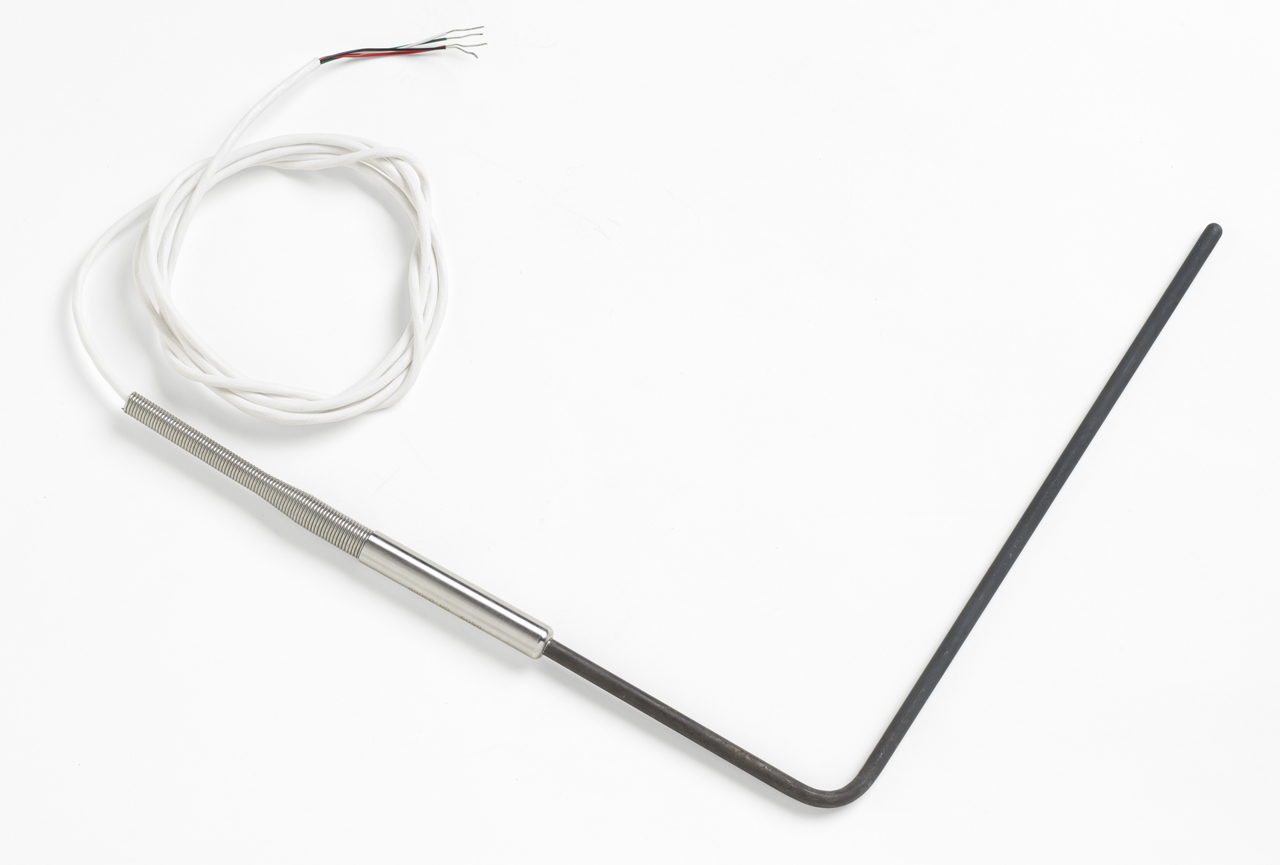
The Fluke Calibration 5609 is a high-precision secondary reference platinum resistance thermometer (PRT) designed for professional temperature calibration and reference measurements over a wide temperature range from −200 °C to +670 °C. With excellent short-term stability, a robust Inconel sheath and four-wire resistance measurement, the Fluke Calibration 5609 is particularly suitable for calibration laboratories, temperature comparison measurements and demanding industrial temperature metrology.
The Fluke Calibration 5609 is designed for applications requiring a wider temperature range than the Fluke Calibration 5608. While the 5608 operates up to 500 °C, the 5609 extends the upper temperature limit to 670 °C, making it suitable for high-temperature calibration applications.
As a secondary reference thermometer, the Fluke Calibration 5609 can be used as a reference probe in liquid baths, calibration furnaces and suitable dry-block temperature calibrators. When combined with a precision thermometer readout, it forms a highly accurate temperature measurement system.
The probe uses a precision platinum resistance sensing element. Its four-wire connection minimizes errors caused by lead resistance, which is particularly important for high-accuracy resistance and temperature measurements.
The manufacturer specifies excellent short-term stability of ±0.01 °C at 0.01 °C. The robust construction and high-temperature Inconel sheath support reliable operation over repeated calibration cycles.
The Fluke Calibration 5609 is available in different probe lengths and connector configurations, allowing the thermometer to be adapted to different laboratory equipment and thermometer readouts.
At europascal, the Fluke Calibration 5609 provides a professional solution for reference temperature measurement and calibration applications up to 670 °C.
For professional calibration and metrological traceability, visit the europascal Calibration Service.
Your Benefits at a Glance
- High-precision secondary reference PRT
- Wide temperature range from −200 °C to +670 °C
- Suitable for demanding laboratory calibration
- Precision platinum resistance sensing element
- Excellent short-term stability
- Robust Inconel sheath
- Four-wire resistance measurement
- Reduced influence of lead resistance
- Suitable for liquid calibration baths
- Suitable for calibration furnaces
- Suitable for compatible dry-block calibrators
- Suitable for temperature comparison calibration
- Multiple probe lengths available
- Different connector configurations available
- Optional accredited calibration
- Individual calibration coefficients available
- Suitable for ITS-90-based temperature measurement
- Compatible with suitable precision thermometer readouts
- Professional calibration support from europascal
Wide Temperature Range from −200 °C to +670 °C
One of the main advantages of the Fluke Calibration 5609 is its wide temperature range:
−200 °C to +670 °C
This range makes the thermometer suitable for a broad variety of temperature calibration applications.
At the lower end of its range, the probe can be used for cryogenic and low-temperature measurements.
At higher temperatures, the 5609 can be used for reference measurements in calibration furnaces and suitable dry-block calibrators.
The upper temperature limit of 670 °C makes the Fluke Calibration 5609 particularly useful for laboratories requiring a reference thermometer beyond the 500 °C limit of the Fluke Calibration 5608.
Secondary Reference Platinum Resistance Thermometer
The Fluke Calibration 5609 is designed as a secondary reference thermometer.
In a temperature calibration laboratory, secondary reference thermometers are commonly used to transfer temperature values from higher-level reference standards to working standards or devices under test.
A calibrated Fluke Calibration 5609 can therefore be used as a reference during comparison calibrations.
For example, the reference thermometer and a device under test can be placed in the same stable temperature source.
The indication error can then be determined as:
ΔT = T_DUT − T_REF
where:
- ΔT = indication error
- T_DUT = temperature indicated by the device under test
- T_REF = reference temperature measured with the Fluke Calibration 5609
The achievable measurement uncertainty depends on the complete measurement system and calibration procedure.
Precision Platinum Resistance Element
The Fluke Calibration 5609 uses a high-quality platinum resistance sensing element.
Platinum is widely used in precision temperature metrology because its electrical resistance changes reproducibly with temperature.
A precision thermometer readout supplies the measuring current and determines the electrical resistance of the sensor.
The measured resistance is then converted into temperature using the appropriate resistance-temperature relationship or individual calibration coefficients.
This allows the Fluke Calibration 5609 to provide accurate and reproducible reference temperature measurements.
Four-Wire Resistance Measurement
The Fluke Calibration 5609 uses a four-wire electrical connection.
This is an important feature for precision resistance thermometry.
With a two-wire sensor connection, the resistance of the connecting leads is included in the measured resistance.
For a platinum resistance thermometer, even a relatively small additional resistance can produce a significant temperature error.
Four-wire measurement separates the current and voltage connections.
As a result, the resistance of the connecting wires has very little influence on the measured sensor resistance.
This method is therefore preferred for precision PRT measurements.
Excellent Short-Term Stability
Reference thermometers require excellent stability.
The Fluke Calibration 5609 is designed to maintain stable characteristics during repeated temperature measurements.
Fluke specifies excellent short-term stability under defined test conditions.
At the triple point of water, the specified short-term stability is:
±0.01 °C at 0.01 °C
Stability is particularly important when a reference thermometer is repeatedly cycled between different calibration temperatures.
However, stability must not be confused with absolute accuracy.
The actual temperature uncertainty depends on the individual calibration of the probe and the performance of the connected thermometer readout.
Inconel Probe Sheath
The Fluke Calibration 5609 features an Inconel sheath.
Inconel is a nickel-based alloy commonly used for applications involving elevated temperatures.
Its mechanical and thermal properties make it suitable for reference thermometer probes operating over a wide temperature range.
The sheath protects the precision platinum sensing element while providing the mechanical strength required for regular laboratory use.
Chemical compatibility with the calibration medium must nevertheless be considered.
Probe Diameter and Immersion
The Fluke Calibration 5609 uses a larger probe sheath than the slim Fluke Calibration 5608.
Depending on the selected version, the 5609 is available with a probe diameter of approximately 6 mm / 6.35 mm.
The larger diameter provides a robust construction suitable for temperatures up to 670 °C.
For accurate reference measurements, sufficient immersion depth is essential.
Fluke specifies a minimum immersion depth of approximately:
100 mm
Insufficient immersion can cause heat conduction along the thermometer stem.
This creates a temperature difference between the sensing element and the actual calibration zone.
For high-accuracy measurements, the immersion error should therefore be evaluated under the actual calibration conditions.
Different Probe Lengths
The Fluke Calibration 5609 is available in different probe lengths.
This allows the reference thermometer to be adapted to different calibration baths, dry blocks and furnaces.
Longer probes are particularly useful in calibration furnaces where the homogeneous temperature zone is located deeper inside the equipment.
The correct probe length should be selected according to:
- Required immersion depth
- Calibration furnace geometry
- Dry-block insert dimensions
- Calibration bath depth
- Temperature range
- Required measurement uncertainty
Correct selection of the probe dimensions contributes significantly to reliable temperature measurements.
ITS-90 Calibration
For high-accuracy applications, the Fluke Calibration 5609 can be calibrated and characterized using suitable temperature fixed points.
The resulting calibration data can be used to determine coefficients for temperature calculation.
The International Temperature Scale of 1990 (ITS-90) provides the basis for high-accuracy temperature measurements using calibrated platinum resistance thermometers.
With suitable calibration coefficients, the individual resistance-temperature characteristic of the Fluke Calibration 5609 can be taken into account.
A compatible thermometer readout can then convert the measured resistance into temperature using the stored coefficients.
This provides better measurement performance than using only a generic nominal sensor characteristic.
Optional Accredited Calibration
The Fluke Calibration 5609 can be ordered with an appropriate accredited calibration.
An accredited calibration provides documented measurement results and establishes metrological traceability within the scope of the calibration.
Depending on the selected calibration option, the calibration documentation can include individual resistance values and calibration coefficients.
The calibration option should be selected according to the required temperature range and measurement uncertainty.
An accredited calibration is an option and should not automatically be assumed to be included with every standard 5609 probe.
Triple Point of Water
The triple point of water is one of the most important reference temperatures in precision thermometry.
Its temperature is:
0.01 °C
The resistance of a platinum resistance thermometer at the triple point of water provides an important reference value for evaluating sensor characteristics and stability.
Repeated measurements at the water triple point can be used to detect changes in the resistance of the sensing element.
This makes the water triple point particularly useful for monitoring the long-term behavior of a reference thermometer such as the Fluke Calibration 5609.
Compatible Precision Thermometer Readouts
The Fluke Calibration 5609 is a passive resistance thermometer.
It does not have its own display.
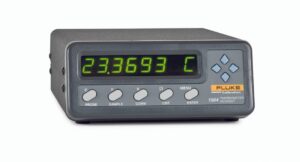
A precision thermometer readout is required to measure the electrical resistance of the PRT and convert it into temperature.
Depending on the selected connector and required measurement uncertainty, the Fluke Calibration 5609 can be combined with suitable Fluke Calibration thermometer readouts and resistance bridges.
A complete reference temperature measurement system therefore consists of:
Fluke Calibration 5609 + precision thermometer readout + valid calibration data
For high-accuracy applications, the uncertainty contribution of the readout must be included in the measurement uncertainty budget.
Temperature Comparison Calibration
The Fluke Calibration 5609 is particularly suitable for comparison calibration.
During comparison calibration, the reference thermometer and the device under test are exposed to the same nominal temperature.
A suitable temperature source may be:
- Liquid calibration bath
- Dry-block calibrator
- Temperature calibration furnace
- Cryogenic calibration system
After thermal equilibrium has been reached, the reference temperature and DUT indication are recorded.
The difference between both values determines the indication error of the device under test.
Use in Calibration Baths
At suitable temperatures, the Fluke Calibration 5609 can be used in liquid calibration baths.
Liquid baths provide excellent temperature stability and uniformity when correctly operated.
The reference thermometer and sensors under test can be positioned close to one another.
This helps reduce uncertainty caused by spatial temperature gradients.
The probe must be sufficiently immersed and chemically compatible with the bath medium.
Use in Dry-Block Calibrators
The Fluke Calibration 5609 can also be used with suitable dry-block temperature calibrators.
A reference probe opening in the calibration insert allows the PRT to measure the actual block temperature.
The use of an external reference thermometer can improve the characterization of the calibration temperature compared with relying only on the internal control sensor of the dry block.
For high-accuracy calibration, axial and radial temperature gradients, loading effects and immersion depth must be considered.
Use in Calibration Furnaces
The extended upper temperature limit of 670 °C makes the Fluke Calibration 5609 particularly useful with temperature calibration furnaces.
At elevated temperatures, the homogeneous temperature zone of the furnace becomes especially important.
The sensing element of the reference thermometer should be positioned within this zone.
The probe must also be immersed sufficiently to minimize heat conduction through the stem.
These considerations become increasingly important as the temperature difference between the calibration zone and ambient temperature increases.
Measurement Uncertainty
The Fluke Calibration 5609 is only one component of the complete measurement chain.
The uncertainty of a temperature measurement can include contributions from:
- Calibration uncertainty of the reference thermometer
- Drift of the PRT
- Resistance measurement accuracy of the readout
- Resolution
- Self-heating
- Repeatability
- Temperature source stability
- Axial temperature gradients
- Radial temperature gradients
- Immersion effects
- Hysteresis
- Interpolation of calibration data
For professional calibration work, these contributions should be evaluated according to the applicable calibration procedure and uncertainty model.
Technical Highlights
| Feature | Fluke Calibration 5609 |
|---|---|
| Product type | Secondary Reference Platinum Resistance Thermometer |
| Manufacturer | Fluke Calibration |
| Temperature range | −200 °C to +670 °C |
| Sensor technology | Platinum Resistance Thermometer |
| Short-term stability at 0.01 °C | ±0.01 °C |
| Sheath material | Inconel |
| Probe diameter | Approx. 6 mm / 6.35 mm depending on version |
| Minimum immersion depth | Approx. 100 mm |
| Electrical connection | Four-wire |
| Probe lengths | Multiple versions available |
| ITS-90 calibration | Available |
| Accredited calibration | Optional |
| Integrated display | No |
| Temperature generation | No |
| Main application | Secondary reference temperature measurement |
Fluke Calibration 5608 vs. Fluke Calibration 5609
The Fluke Calibration 5608 and 5609 are both secondary reference platinum resistance thermometers, but they are optimized for different applications.
| Feature | Fluke Calibration 5608 | Fluke Calibration 5609 |
|---|---|---|
| Temperature range | −200 °C to +500 °C | −200 °C to +670 °C |
| Probe diameter | 3.18 mm | Approx. 6–6.35 mm |
| Minimum immersion | 80 mm | Approx. 100 mm |
| Short-term stability | ±0.01 °C | ±0.01 °C at 0.01 °C |
| Sheath material | Inconel | Inconel |
| Four-wire measurement | Yes | Yes |
| Accredited calibration | Optional | Optional |
| Main advantage | Slim probe | Extended high-temperature range |
The Fluke Calibration 5608 is particularly useful where a slim probe and relatively shallow immersion are required.
The Fluke Calibration 5609 is the better choice when the application requires reference measurements above 500 °C and up to 670 °C.
Typical Applications
The Fluke Calibration 5609 is suitable for:
- Secondary reference temperature measurements
- Temperature calibration laboratories
- PRT calibration
- Pt100 calibration
- Temperature comparison calibration
- High-temperature calibration
- Calibration furnaces
- Dry-block temperature calibrators
- Liquid calibration baths
- Cryogenic temperature measurement
- Temperature stability testing
- Temperature uniformity testing
- Industrial temperature sensor calibration
- Research laboratories
- Quality assurance
- Reference temperature measurement
- Temperature metrology
Calibration by europascal
Regular calibration is essential for maintaining reliable reference temperature measurements.
europascal provides professional calibration services for temperature measuring instruments and temperature measurement systems.
The Fluke Calibration 5609 can be calibrated to determine its individual resistance-temperature relationship.
When combined with a suitable precision thermometer readout, the probe can form part of a traceable reference temperature measurement system.
The complete measurement uncertainty depends on the calibration uncertainty of the PRT, the thermometer readout, sensor stability and the conditions of use.
For professional calibration and metrological traceability, visit the europascal Calibration Service.
europascal also supports customers in selecting suitable reference thermometers, thermometer readouts and temperature calibration equipment.
Why Choose the Fluke Calibration 5609?
The Fluke Calibration 5609 combines a wide temperature range, excellent stability and robust construction in a professional secondary reference thermometer.
Its operating range from −200 °C to +670 °C allows the same reference thermometer family to cover applications from low-temperature calibration to demanding high-temperature measurements.
The Inconel sheath provides a robust construction for repeated laboratory use.
Four-wire resistance measurement minimizes errors caused by lead resistance.
Optional accredited calibration and individual calibration coefficients support traceable high-accuracy temperature measurements.
Compared with the Fluke Calibration 5608, the 5609 provides an extended upper temperature range of 670 °C.
This makes it particularly suitable for calibration laboratories working with temperature furnaces, dry-block calibrators and industrial temperature sensors at elevated temperatures.
For professional temperature metrology, the Fluke Calibration 5609 provides an excellent combination of measurement performance, stability and temperature range.
europascal supports customers with reference temperature probes, calibration equipment and professional calibration services.