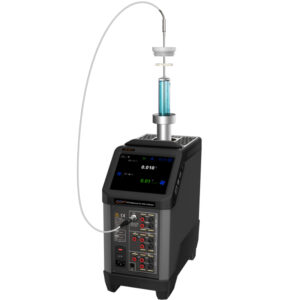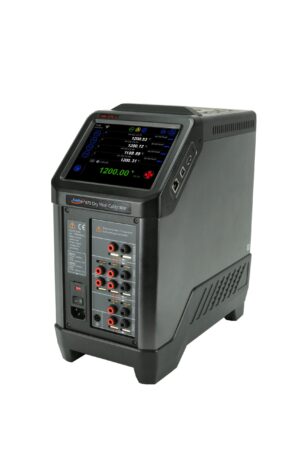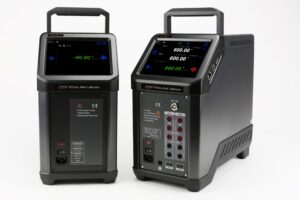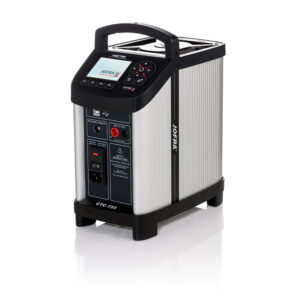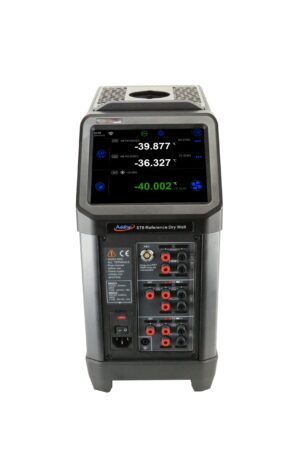
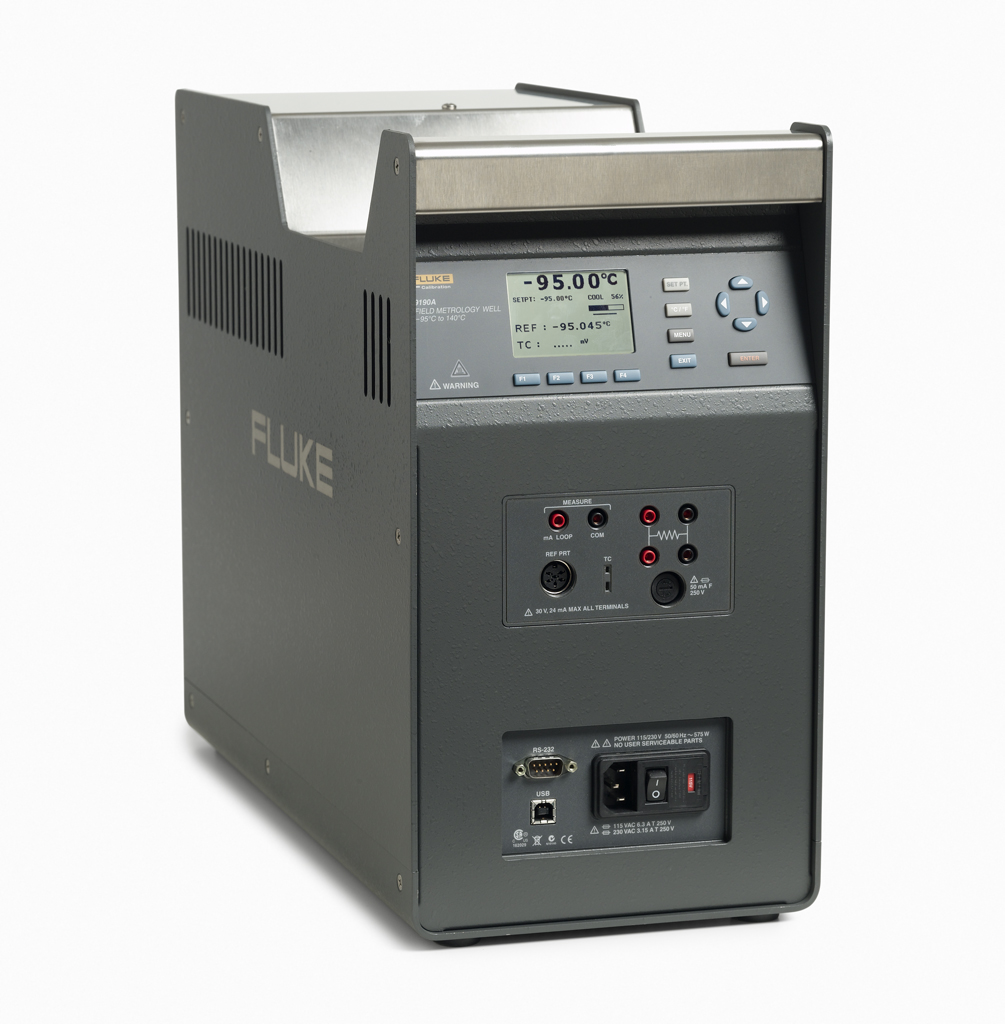
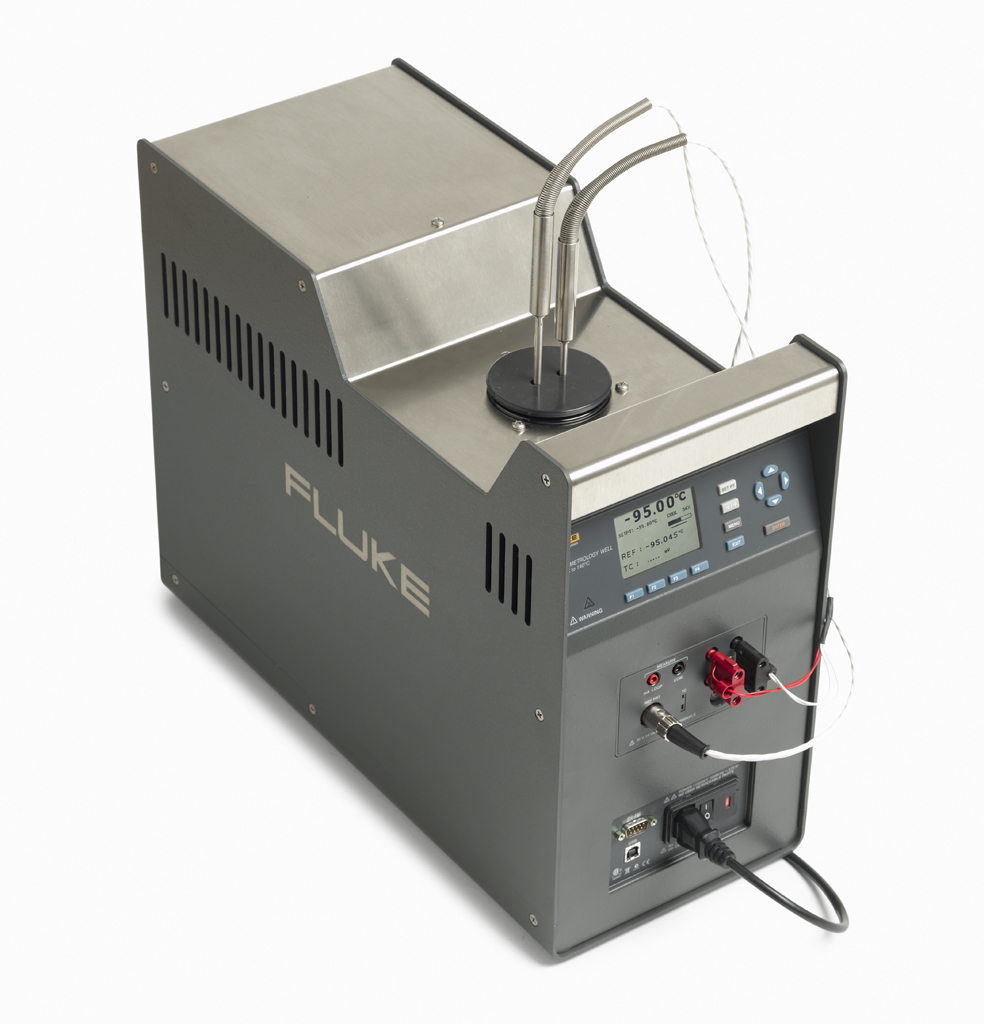
The Fluke Calibration 9190A is a high-precision, portable ultra-cool field metrology well designed for demanding temperature calibration applications in laboratories, pharmaceutical manufacturing, biotechnology, aerospace and industrial quality assurance.
With an exceptionally wide temperature range from −95 °C to +140 °C, excellent temperature stability of ±0.015 °C and display accuracy of ±0.2 °C, the Fluke Calibration 9190A provides outstanding performance for low-temperature calibration.
When used with a suitable external reference thermometer, the instrument offers a specified system accuracy of ±0.05 °C across its entire temperature range under the manufacturer’s defined conditions.
Unlike conventional liquid calibration baths, the Fluke Calibration 9190A uses a dry-block system with interchangeable inserts. This eliminates the need for calibration liquids and makes the instrument particularly suitable for cleanrooms and environments where contamination must be avoided.
The compact design, integrated cooling technology and excellent temperature uniformity make the Fluke Calibration 9190A an ideal solution for calibrating platinum resistance thermometers, industrial RTDs, thermocouples and temperature sensors.
For professional temperature calibration equipment and metrological traceability, visit the europascal Calibration Service.
Your Benefits at a Glance
- Wide temperature range from −95 °C to +140 °C
- Display accuracy of ±0.2 °C across the entire range
- Accuracy of ±0.05 °C with a suitable external reference thermometer
- Excellent temperature stability of ±0.015 °C
- Axial temperature uniformity of ±0.05 °C
- Radial temperature gradient of ±0.01 °C
- Low loading effect of ±0.006 °C under specified conditions
- Calibration well depth of 160 mm
- Well diameter of 30 mm
- Interchangeable calibration inserts
- Suitable for simultaneous calibration of multiple sensors
- Cooling down to −95 °C without calibration liquids
- Typical heating time of 40 minutes from −95 °C to +140 °C
- Typical stabilization time of 15 minutes
- Compact and portable construction
- Weight of approximately 16 kg
- Integrated RS-232 and USB communication interfaces
- Optional process measurement electronics
- Suitable for cleanroom environments
- Ideal for RTD and thermocouple calibration
- Professional calibration support from europascal
Temperature Range from −95 °C to +140 °C
The Fluke Calibration 9190A provides a temperature calibration range of:
−95 °C to +140 °C
This exceptionally wide temperature range makes the instrument suitable for low-temperature applications that cannot be covered by conventional portable dry-block calibrators.
The temperature range is specified at an ambient temperature of 23 °C.
Typical calibration temperatures include:
- −95 °C
- −80 °C
- −60 °C
- −40 °C
- −20 °C
- 0 °C
- +25 °C
- +50 °C
- +100 °C
- +140 °C
The ability to generate temperatures down to −95 °C is particularly useful for calibration applications in pharmaceutical manufacturing, environmental testing, aerospace and industrial temperature metrology.
Excellent Temperature Accuracy
The Fluke Calibration 9190A provides two important accuracy specifications.
Display Accuracy
The manufacturer specifies:
±0.2 °C across the entire temperature range
This specification describes the accuracy of the internal temperature indication under the manufacturer’s defined operating conditions.
Accuracy with External Reference
When a suitable external reference thermometer is used, the manufacturer specifies:
±0.05 °C across the entire temperature range
This allows significantly more accurate comparison calibrations.
The external reference thermometer measures the actual temperature within the calibration insert.
The device under test can then be compared directly with the reference thermometer.
For demanding applications, the uncertainty of the complete calibration system must be evaluated.
Outstanding Temperature Stability
The Fluke Calibration 9190A provides excellent temperature stability.
The manufacturer specifies:
±0.015 °C
This specification applies across the entire temperature range.
Temperature stability describes the variation of the calibration block temperature over time under defined operating conditions.
High temperature stability is particularly important when calibrating precision resistance thermometers and other demanding temperature sensors.
The stable temperature environment helps minimize measurement variations during calibration.
Excellent Axial Temperature Uniformity
The Fluke Calibration 9190A provides excellent axial temperature uniformity.
The manufacturer specifies:
±0.05 °C at 40 mm
This specification describes temperature differences along the specified axial measurement region.
Good axial temperature uniformity helps reduce measurement errors caused by differences in sensor immersion depth.
It is particularly important when calibrating sensors with different sensing element lengths.
Excellent Radial Temperature Uniformity
The Fluke Calibration 9190A provides outstanding radial temperature uniformity.
The manufacturer specifies a radial temperature gradient of:
±0.01 °C
This specification describes temperature differences between different positions within the calibration insert.
Excellent radial uniformity allows multiple sensors to be calibrated simultaneously under nearly identical temperature conditions.
This is particularly useful for comparison calibrations using an external reference thermometer.
Low Loading Effect
The Fluke Calibration 9190A is designed to minimize temperature changes caused by inserting multiple sensors into the calibration block.
The manufacturer specifies a loading effect of:
±0.006 °C
This value applies under specified conditions with one 6.35 mm reference probe and three additional 6.35 mm probes.
Low loading effects are particularly important when calibrating multiple sensors simultaneously.
The actual loading effect depends on the number, diameter and thermal characteristics of the inserted sensors.
Deep Calibration Well
The Fluke Calibration 9190A features a calibration well with a depth of:
160 mm
The well diameter is:
30 mm
The deep calibration well helps minimize heat conduction errors along the sensor stem.
Sufficient immersion depth is essential for accurate temperature calibration.
The actual required immersion depth depends on sensor geometry, sensing element position and the required measurement uncertainty.
Interchangeable Calibration Inserts
The Fluke Calibration 9190A uses interchangeable calibration inserts.
Different insert configurations are available for sensors with various diameters.
Available configurations include:
| Insert | Configuration |
|---|---|
| 9190-INSA | Mixed imperial bore sizes |
| 9190-INSB | Imperial comparison bores |
| 9190-INSC | Six 6.35 mm bores |
| 9190-INSD | Metric comparison bores |
| 9190-INSE | Mixed metric bores |
| 9190-INSF | Metric comparison bores |
| 9190-INSZ | Blank insert |
| 9190-INSTC | Thermocouple insert with radial grooves |
The appropriate insert should be selected according to the diameter and geometry of the sensors being calibrated.
Good thermal contact between the sensor and insert helps minimize temperature differences.
Fast Heating Performance
The Fluke Calibration 9190A provides efficient heating performance.
The manufacturer specifies:
40 minutes from −95 °C to +140 °C
This allows the instrument to cover its entire temperature range within a relatively short time.
Fast heating is particularly useful when performing multi-point calibration procedures.
Actual heating times depend on ambient conditions, sensor loading and the selected insert.
Cooling Performance
The Fluke Calibration 9190A features an integrated cooling system capable of generating temperatures down to −95 °C.
Typical cooling times include:
| Temperature Change | Typical Cooling Time |
|---|---|
| +23 °C to −90 °C | 80 minutes |
| +23 °C to −95 °C | 90 minutes |
| +140 °C to +23 °C | 60 minutes |
The integrated cooling technology eliminates the need for external liquid nitrogen or separate refrigeration equipment during normal operation.
This simplifies low-temperature calibration procedures.
Temperature Stabilization
The manufacturer specifies a typical stabilization time of:
15 minutes
This describes the time required for the instrument to stabilize under the specified operating conditions.
The stabilization time of the reference thermometer and device under test must also be considered.
For demanding calibration applications, sufficient time should be allowed for the entire measurement system to reach thermal equilibrium.
Ideal for Cleanroom Applications
The Fluke Calibration 9190A is particularly suitable for cleanroom environments.
Unlike liquid calibration baths, the instrument does not require calibration fluids.
This eliminates the risk of contamination caused by leaking or evaporating bath liquids.
The dry-block design also simplifies cleaning and maintenance.
Typical cleanroom applications include pharmaceutical manufacturing, biotechnology and precision production environments.
The suitability of the complete calibration procedure for a particular cleanroom classification must be evaluated separately.
Calibration of Pt100 and RTD Sensors
The Fluke Calibration 9190A is suitable for calibrating resistance temperature detectors.
Typical applications include:
- Pt100 calibration
- Pt1000 calibration
- Industrial RTD calibration
- Precision resistance thermometer calibration
- Temperature probe verification
The temperature sensor is inserted into a suitable calibration insert.
The calibration block generates a stable reference temperature.
The temperature indicated by the device under test can then be compared with the reference temperature.
For high-accuracy applications, a calibrated external reference thermometer is recommended.
Calibration of Thermocouples
The Fluke Calibration 9190A can also be used for thermocouple calibration.
The instrument provides a stable temperature environment for checking thermocouple measurement systems.
The thermocouple is inserted into a suitable calibration insert and allowed to stabilize.
Its indicated temperature can then be compared with the reference temperature.
For accurate thermocouple calibration, reference junction compensation and the uncertainty of the measurement instrument must be considered.
A dedicated thermocouple insert with radial grooves is available for suitable wire-type thermocouples.
Optional Process Measurement Electronics
The Fluke Calibration 9190A is available in different configurations.
Fluke Calibration 9190A
The standard model provides precise temperature generation and control.
It is designed for use with external reference thermometers and measurement instruments.
Fluke Calibration 9190A-P
The 9190A-P includes additional process measurement electronics.
These provide measurement functions for:
- Reference platinum resistance thermometers
- Industrial RTDs
- Thermocouples
- DC current signals
- Temperature transmitters
The integrated reference thermometer input supports four-wire resistance measurements.
The process module also provides a 24 V DC loop power supply for compatible temperature transmitters.
These additional measurement functions are available only with the 9190A-P configuration.
RS-232 and USB Communication
The Fluke Calibration 9190A includes communication interfaces for integration into calibration systems.
Available interfaces include:
- RS-232
- USB serial
These interfaces allow remote operation and communication with compatible calibration software.
The instrument can be integrated into automated calibration procedures.
This helps improve efficiency when performing repeated calibration tasks.
Technical Highlights
| Specification | Fluke Calibration 9190A |
|---|---|
| Manufacturer | Fluke Calibration |
| Model | 9190A |
| Product type | Ultra-Cool Field Metrology Well |
| Temperature range | −95 °C to +140 °C |
| Display accuracy | ±0.2 °C |
| Accuracy with external reference | ±0.05 °C |
| Temperature stability | ±0.015 °C |
| Axial uniformity at 40 mm | ±0.05 °C |
| Radial temperature gradient | ±0.01 °C |
| Loading effect | ±0.006 °C under specified conditions |
| Well depth | 160 mm |
| Well diameter | 30 mm |
| Calibration inserts | Interchangeable |
| Heating time, −95 °C to +140 °C | 40 minutes |
| Cooling time, +23 °C to −95 °C | 90 minutes |
| Typical stabilization time | 15 minutes |
| Display resolution | 0.01 °C |
| Display | LCD |
| Communication interfaces | RS-232, USB serial |
| Operating temperature | 0 °C to +35 °C |
| Power supply | 100–115 V or 200–230 V AC |
| Power consumption | 575 W |
| Dimensions (H × W × D) | 480 × 205 × 380 mm |
| Weight | Approx. 16 kg |
| Optional process electronics | 9190A-P |
| Typical applications | RTD, thermocouple and precision thermometer calibration |
Calibration Service by europascal
Regular calibration is essential for maintaining reliable and traceable temperature measurements.
europascal provides professional calibration services for temperature measuring instruments and calibration equipment.
When the Fluke Calibration 9190A is used for temperature sensor calibration, the measurement uncertainty must be evaluated according to the complete measurement procedure.
Relevant uncertainty contributions may include:
- Calibration block temperature accuracy
- Temperature stability
- Axial temperature uniformity
- Radial temperature uniformity
- Reference thermometer calibration uncertainty
- Thermometer readout uncertainty
- Sensor immersion effects
- Thermal contact between sensor and calibration insert
- Loading effects
- Measurement repeatability
The individual uncertainty contributions must be evaluated carefully to avoid double-counting effects already included in the manufacturer’s specifications.
For professional calibration services and metrological traceability, visit the europascal Calibration Service.
Why Choose the Fluke Calibration 9190A?
The Fluke Calibration 9190A combines outstanding low-temperature calibration performance with a compact and portable design.
Its temperature range from −95 °C to +140 °C covers demanding industrial and laboratory applications.
Excellent temperature stability of ±0.015 °C and outstanding axial and radial temperature uniformity provide reliable conditions for precision calibration.
The instrument can achieve a specified accuracy of ±0.05 °C when used with a suitable external reference thermometer.
Interchangeable calibration inserts allow multiple sensors to be calibrated simultaneously.
The dry-block design eliminates the need for calibration liquids and makes the instrument particularly suitable for cleanroom environments.
Integrated RS-232 and USB communication interfaces support computer-assisted calibration procedures.
The optional 9190A-P configuration adds integrated reference thermometer and process measurement capabilities.
For calibration laboratories, pharmaceutical manufacturers, biotechnology companies and industrial users requiring a high-performance low-temperature calibrator, the Fluke Calibration 9190A provides an excellent combination of accuracy, flexibility and convenience.
europascal supports customers with professional temperature calibration equipment, technical advice and calibration services.
Typical Applications for the Fluke Calibration 9190A
Typical applications include:
- Low-temperature sensor calibration
- Pt100 calibration
- Pt1000 calibration
- RTD calibration
- Precision resistance thermometer calibration
- Thermocouple calibration
- Temperature transmitter calibration
- Pharmaceutical manufacturing
- Biotechnology
- Cleanroom applications
- Aerospace temperature testing
- Environmental monitoring
- Industrial quality assurance
- Calibration laboratories
- Temperature metrology
- Field calibration
- Process instrumentation maintenance
The combination of an exceptionally wide temperature range, excellent temperature stability, outstanding uniformity and portable construction makes the Fluke Calibration 9190A a professional solution for demanding temperature calibration applications.
Find more Fluke Calibration products here.
Manufacturer information for the Fluke Calibration 9190A can be found on the official Fluke Calibration website.