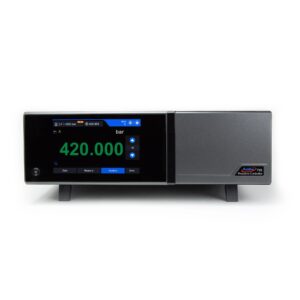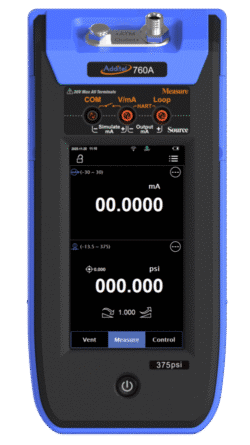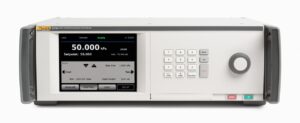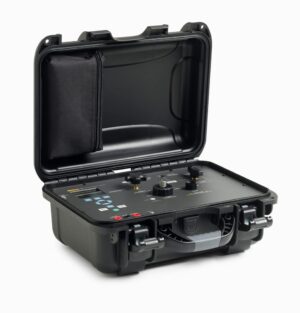
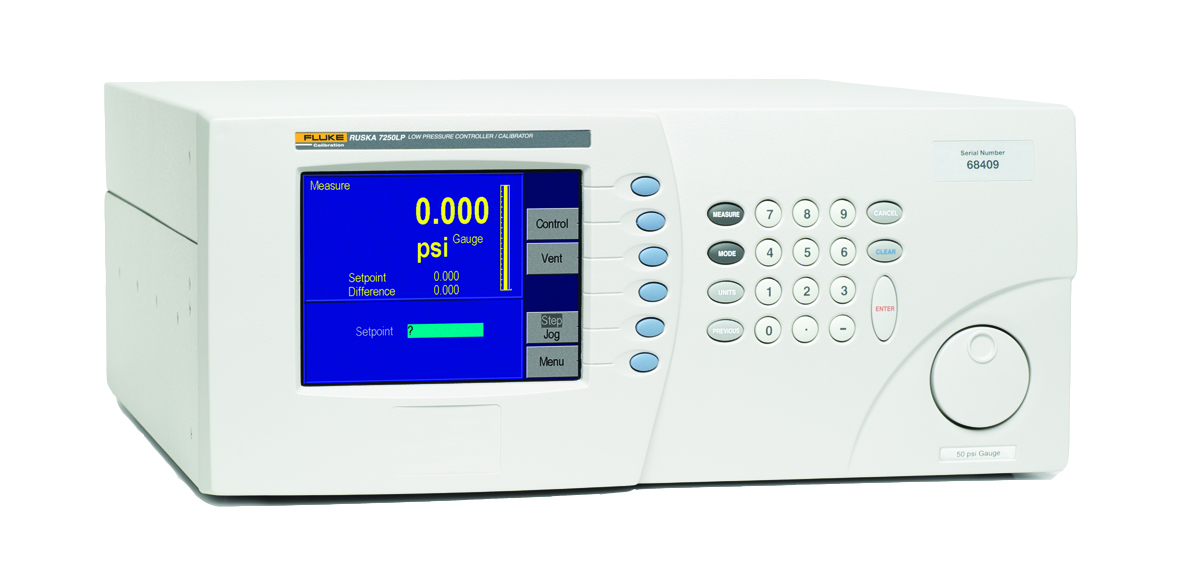
Fluke Calibration RUSKA 7250LP is a precise low pressure controller and calibrator specifically designed for accurate measurement and automatic control of low differential pressures. As part of the proven RUSKA 7250 family, the 7250LP combines high-performance quartz Bourdon tube pressure sensing technology with automatic pressure regulation and dual-range capability in a single laboratory instrument.
The RUSKA 7250LP is particularly suitable for calibrating low-pressure sensors, differential pressure transducers, mechanical pressure gauges, portable calibrators and plug-in pressure modules. Its combination of excellent measurement performance and automatic pressure control makes it ideal for calibration laboratories, HVAC applications, process instrumentation, research and other applications where small differential pressures must be generated and measured accurately.
Three dual-range configurations are available:
- 10 / 30 inH₂O – 25 / 75 mbar
- 20 / 60 inH₂O – 50 / 150 mbar
- 35 / 100 inH₂O – 87 / 250 mbar
The instrument automatically changes between its two internal ranges, allowing excellent measurement performance over a much broader workload without requiring manual intervention.
Precision is specified at 0.005 % of reading over the upper portion of the measurement range. Control stability is 0.004 % of each active range, while display resolution can be selected up to 1:1,000,000.
An optional negative gauge pressure configuration enables the RUSKA 7250LP to calibrate bidirectional differential pressure devices using both positive and negative gauge pressure.
At europascal, we provide professional solutions for pressure calibration ranging from very low differential pressures to high-pressure applications. Our portfolio includes low-pressure controllers, reference pressure indicators, digital pressure calibrators, piston gauges and complete automated calibration systems.
For professional calibration and metrological traceability of pressure controllers, differential pressure instruments and pressure measuring equipment, use the europascal Calibration Service.
Your Benefits at a Glance
- High-precision low pressure controller and calibrator
- Designed specifically for low differential pressure
- RUSKA quartz Bourdon tube pressure sensor technology
- Three available dual-range configurations
- Maximum pressure up to 100 inH₂O
- Maximum pressure up to 250 mbar
- Precision of 0.005 % of reading
- Control stability of 0.004 % of each range
- Automatic range switching
- Dual-range architecture
- Display resolution up to 1:1,000,000
- Resolution down to 0.0001 inH₂O
- Typical control response of 20 seconds or less
- No overshoot under specified conditions
- True differential pressure sensor
- Separate reference pressure connection
- Optional negative gauge pressure operation
- Automatic pressure generation and regulation
- Nitrogen or clean, dry air as pressure medium
- Suitable for differential pressure sensors
- Suitable for low-pressure transmitters
- Suitable for mechanical pressure gauges
- Suitable for portable calibrators
- Suitable for plug-in pressure modules
- Ideal for professional calibration laboratories
- Suitable for automated calibration systems
Designed for Low Differential Pressure Calibration
The Fluke Calibration RUSKA 7250LP was specifically developed for low differential pressure calibration.
Very low pressure measurement presents challenges that are less significant at higher pressures.
Small disturbances caused by:
- Air currents
- HVAC systems
- Temperature changes
- Reference pressure fluctuations
- Pneumatic tubing
- Height differences
- Environmental pressure changes
can significantly influence low-pressure measurements.
The 7250LP addresses these challenges with a dedicated differential pressure sensor and precise automatic pressure control.
This makes it especially suitable for laboratories that require reliable calibration at pressures measured in inches of water column or millibar.
Three Dual-Range Configurations
The Fluke Calibration RUSKA 7250LP is available in three different range combinations.
Each instrument incorporates two pressure ranges.
10 / 30 inH₂O
The lowest range configuration provides:
10 inH₂O and 30 inH₂O
corresponding to approximately:
25 mbar and 75 mbar
This configuration is particularly suitable for very low differential pressure devices.
20 / 60 inH₂O
The intermediate configuration provides:
20 inH₂O and 60 inH₂O
corresponding to approximately:
50 mbar and 150 mbar
This provides additional pressure capability while maintaining excellent low-pressure performance.
35 / 100 inH₂O
The highest 7250LP configuration provides:
35 inH₂O and 100 inH₂O
corresponding to approximately:
87 mbar and 250 mbar
This configuration extends the low-pressure workload up to 250 mbar.
Automatic Range Switching
A major advantage of the Fluke Calibration RUSKA 7250LP is automatic range selection.
Because every 7250LP incorporates two pressure ranges, the instrument can select the appropriate range according to the pressure being generated and measured.
Range switching occurs automatically in both directions.
The operator therefore does not need to manually select a different reference sensor as the pressure changes.
This improves usability while maintaining excellent measurement performance across the instrument’s pressure range.
Quartz Bourdon Tube Pressure Sensor
The Fluke Calibration RUSKA 7250LP uses a specialized quartz Bourdon tube pressure sensor.
Quartz sensor technology provides excellent characteristics for precision pressure measurement, including:
- High stability
- Excellent repeatability
- Low hysteresis
- High resolution
- Long-term measurement performance
The sensor technology is particularly important at low differential pressures, where even very small measurement errors can become significant.
The quartz Bourdon tube technology is a defining feature of the RUSKA precision pressure product family.
Precision of 0.005 % of Reading
The Fluke Calibration RUSKA 7250LP provides precision of:
0.005 % of reading
over the specified upper portion of its active range.
Below this threshold, a fixed error specification based on the threshold pressure applies.
The percent-of-reading specification provides excellent rangeability compared with a conventional full-scale-only specification.
This is particularly valuable for laboratories that need to calibrate devices over a wide portion of their measurement range.
Excellent Control Stability
Accurate measurement alone is not sufficient for low-pressure calibration.
The generated pressure must also remain stable.
In active control mode, the Fluke Calibration RUSKA 7250LP provides control stability of:
0.004 % of each active range
In passive mode, no additional uncertainty is specified from pressure control.
Stable pressure generation allows reliable measurements to be made after the selected calibration point has been reached.
Fast Automatic Pressure Control
The RUSKA 7250LP automatically generates and regulates pneumatic pressure.
The operator enters the desired setpoint and the controller automatically approaches and stabilizes the pressure.
Under the manufacturer’s specified conditions, typical control response is:
20 seconds or less
for 10 % full-scale pressure changes into the specified test volume.
The control system is designed to reach the target pressure without overshoot under these conditions.
Automatic pressure control can significantly improve calibration efficiency compared with manual pressure generation.
True Differential Pressure Measurement
The Fluke Calibration RUSKA 7250LP uses a true differential pressure sensor.
This is particularly important for very low-pressure measurements.
The reference port can be connected to the same reference environment as the device under test.
This helps reduce unwanted pressure disturbances caused by air movement in the laboratory.
For example, heating, ventilation and air-conditioning systems can produce small local pressure fluctuations.
At very low differential pressures, these disturbances can be significant relative to the pressure being measured.
Connecting the reference pressure appropriately helps reduce these environmental effects.
Optional Negative Gauge Pressure
The RUSKA 7250LP can be configured for negative gauge pressure operation.
This allows the instrument to generate and control pressures below atmospheric pressure.
The option is especially useful for bidirectional pressure devices.
Typical applications include:
- ± differential pressure transmitters
- Bidirectional low-pressure sensors
- Compound pressure instruments
- HVAC differential pressure sensors
- Negative pressure gauges
The optional negative gauge mode allows both positive and negative pressure points to be generated automatically.
Calibration of Differential Pressure Sensors
Differential pressure sensors are widely used in industrial and laboratory applications.
Typical applications include:
- Air flow measurement
- Filter monitoring
- Cleanroom pressure monitoring
- Ventilation systems
- Building automation
- Process control
- Leak testing
The Fluke Calibration RUSKA 7250LP provides the stable and accurately measured differential pressure required to calibrate these sensors.
Automatic pressure control makes multipoint calibration particularly efficient.
HVAC and Building Automation
Low differential pressure measurement is extremely important in HVAC and building automation.
Pressure differences are used to monitor:
- Air filters
- Ventilation ducts
- Cleanrooms
- Building pressure
- Air flow
- Fan performance
These applications often involve pressures measured in only a few inches of water column.
The high resolution and low-pressure capability of the RUSKA 7250LP make it well suited for calibration of instrumentation used in these systems.
Calibration of Mechanical Low-Pressure Gauges
Mechanical low-pressure gauges can also be calibrated using the Fluke Calibration RUSKA 7250LP.
The controller generates a defined differential pressure and automatically stabilizes at the selected calibration point.
The indication of the mechanical gauge is then compared with the reference pressure measured by the 7250LP.
Several increasing and decreasing pressure points can be generated.
Depending on the calibration procedure, characteristics such as:
- Indication deviation
- Repeatability
- Hysteresis
- Zero deviation
can be evaluated.
Calibration of Portable Calibrators
Portable low-pressure calibrators and their pressure modules can also be calibrated with the RUSKA 7250LP.
The controller provides an accurately generated and measured pressure that can be compared directly with the indication of the portable calibrator.
Automatic pressure generation is particularly useful when several calibration points must be tested.
This can significantly reduce operator workload compared with manual pressure generation.
Calibration of Plug-In Pressure Modules
Pressure modules used with multifunction process calibrators can require calibration at very low differential pressures.
The Fluke Calibration RUSKA 7250LP is specifically designed for these applications.
The combination of:
- Low-pressure capability
- High resolution
- Automatic pressure control
- Dual-range operation
- Excellent precision
makes it particularly useful for calibration of plug-in pressure modules.
Fluke also provides application information for automated calibration of Fluke 700 Series Pressure Modules using the 7250LP.
Resolution Down to 0.0001 inH₂O
The Fluke Calibration RUSKA 7250LP provides extremely high display resolution.
Resolution can be selected down to:
0.0001 inH₂O
The overall display resolution is user selectable up to:
1:1,000,000
This allows very small pressure changes to be observed.
High display resolution is particularly valuable when evaluating pressure stability or working at very low differential pressures.
Display resolution should not be confused with measurement accuracy, but it is an important practical feature for precision calibration.
Long-Term Stability
The Fluke Calibration RUSKA 7250LP provides annual stability of:
0.0075 % of reading per year
Long-term stability is an important characteristic for a laboratory reference instrument.
Stable sensor performance helps maintain predictable measurement uncertainty between calibration intervals.
The specified calibration interval is:
one year
Regular calibration provides the metrological traceability required for professional calibration work.
Nitrogen or Clean Dry Air
The 7250LP is a pneumatic pressure controller.
The specified pressure medium is:
Nitrogen or clean, dry air
Using clean pressure media helps protect the sensitive internal pressure measurement and control system from contamination.
Moisture, oil and particles should be prevented from entering the controller.
A suitable contamination protection strategy is especially important when devices under test may contain residual contamination.
Pressure Comparison Calibration
A typical calibration procedure using the Fluke Calibration RUSKA 7250LP can include:
- Connecting the device under test.
- Connecting the reference port appropriately.
- Selecting the required pressure unit.
- Entering the first pressure setpoint.
- Allowing the controller to generate and stabilize the pressure.
- Recording the device-under-test indication.
- Moving automatically to the next calibration point.
- Repeating the sequence over increasing and decreasing pressures.
This approach provides a repeatable method for calibrating low-pressure devices.
Automated Calibration
The RUSKA 7250 family is designed for integration into automated pressure calibration systems.
Computer-controlled operation allows calibration software to:
- Set pressure values
- Monitor reference pressure
- Wait for pressure stability
- Record measurement values
- Change pressure points
- Perform increasing and decreasing sequences
Automation is particularly beneficial when many similar pressure instruments must be calibrated.
It can improve productivity while reducing repetitive manual operations.
Technical Highlights
The Fluke Calibration RUSKA 7250LP combines high-accuracy differential pressure measurement with automatic low-pressure control:
- Low Pressure Controller/Calibrator
- Dual-range architecture
- Three available range combinations
- 10 / 30 inH₂O
- 20 / 60 inH₂O
- 35 / 100 inH₂O
- Maximum pressure 100 inH₂O
- Maximum pressure 250 mbar
- Quartz Bourdon tube pressure sensor
- Precision 0.005 % of reading
- Control stability 0.004 % of each range
- Automatic range switching
- Resolution down to 0.0001 inH₂O
- Display resolution up to 1:1,000,000
- Typical control response ≤20 seconds
- True differential pressure measurement
- Optional negative gauge operation
- Nitrogen or clean, dry air
- One-year calibration interval
- Designed for automated calibration
- Suitable for low-pressure sensor calibration
Technical Specifications
| Feature | Fluke Calibration RUSKA 7250LP |
|---|---|
| Manufacturer | Fluke Calibration |
| Model | RUSKA 7250LP |
| Device type | Low Pressure Controller / Calibrator |
| Sensor technology | Quartz Bourdon tube |
| Range configuration 1 | 10 / 30 inH₂O |
| Range configuration 1 SI | 25 / 75 mbar |
| Range configuration 2 | 20 / 60 inH₂O |
| Range configuration 2 SI | 50 / 150 mbar |
| Range configuration 3 | 35 / 100 inH₂O |
| Range configuration 3 SI | 87 / 250 mbar |
| Maximum pressure | 100 inH₂O / 250 mbar |
| Precision | 0.005 % of reading in specified range |
| Annual stability | 0.0075 % of reading |
| Control stability | 0.004 % of each range, active mode |
| Display resolution | Selectable up to 1:1,000,000 |
| Minimum displayed resolution | Down to 0.0001 inH₂O |
| Control response | Typically ≤20 seconds |
| Optional mode | Negative gauge pressure |
| Pressure medium | Nitrogen or clean, dry air |
| Test port | 1/4-inch NPT female |
| Supply connection | 1/4-inch NPT female |
| Display | 6.4-inch TFT VGA |
| Operating temperature | 18 °C to 36 °C |
| Storage temperature | −20 °C to +70 °C |
| Dimensions | 178 × 419 × 483 mm |
| Calibration interval | One year |
| Typical application | Low differential pressure calibration |
Why Choose the Fluke Calibration RUSKA 7250LP?
The Fluke Calibration RUSKA 7250LP is specifically designed for applications where conventional pressure controllers cannot provide sufficient performance at very low differential pressures.
Its dual-range architecture provides excellent measurement capability over a broad portion of the low-pressure workload.
Three configurations cover maximum pressures from 30 to 100 inH₂O, with the largest configuration reaching 250 mbar.
The quartz Bourdon tube differential pressure sensor provides excellent stability, repeatability and measurement resolution.
Precision of 0.005 % of reading and active control stability of 0.004 % of each range make the 7250LP suitable for demanding low-pressure calibration.
Automatic range switching simplifies operation because the appropriate internal pressure range is selected without operator intervention.
The true differential pressure sensor and separate reference connection help reduce measurement disturbances caused by local air currents and environmental pressure fluctuations.
Optional negative gauge operation extends the system to bidirectional pressure devices.
Automatic pressure generation and regulation make multipoint calibration significantly more efficient than manual pressure generation.
For calibration laboratories working with differential pressure sensors, low-pressure transmitters, mechanical gauges, portable calibrators or pressure modules, the RUSKA 7250LP provides a specialized solution for accurate low-pressure measurement and control.
At europascal, we can assist you in selecting the appropriate RUSKA 7250LP range configuration, pressure connections, contamination protection and accessories for your individual low-pressure calibration requirements.
For professional calibration and metrological traceability of low-pressure controllers, differential pressure sensors and other pressure measuring equipment, use the europascal Calibration Service.
Discover more Fluke Calibration products here.
Manufacturer information about the Fluke Calibration RUSKA 7250LP is available on the official Fluke Calibration 7250LP product page.