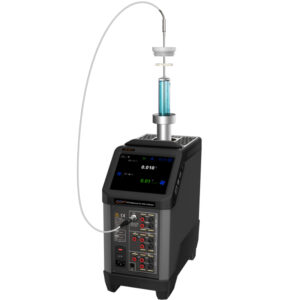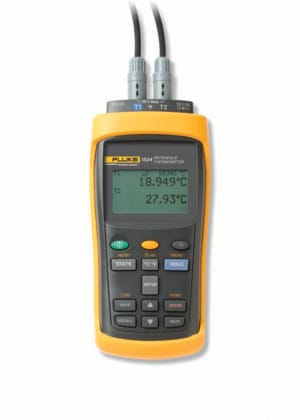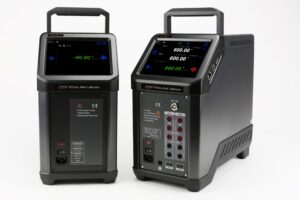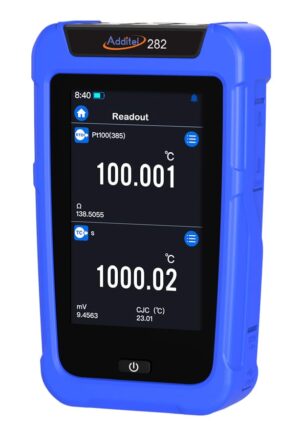
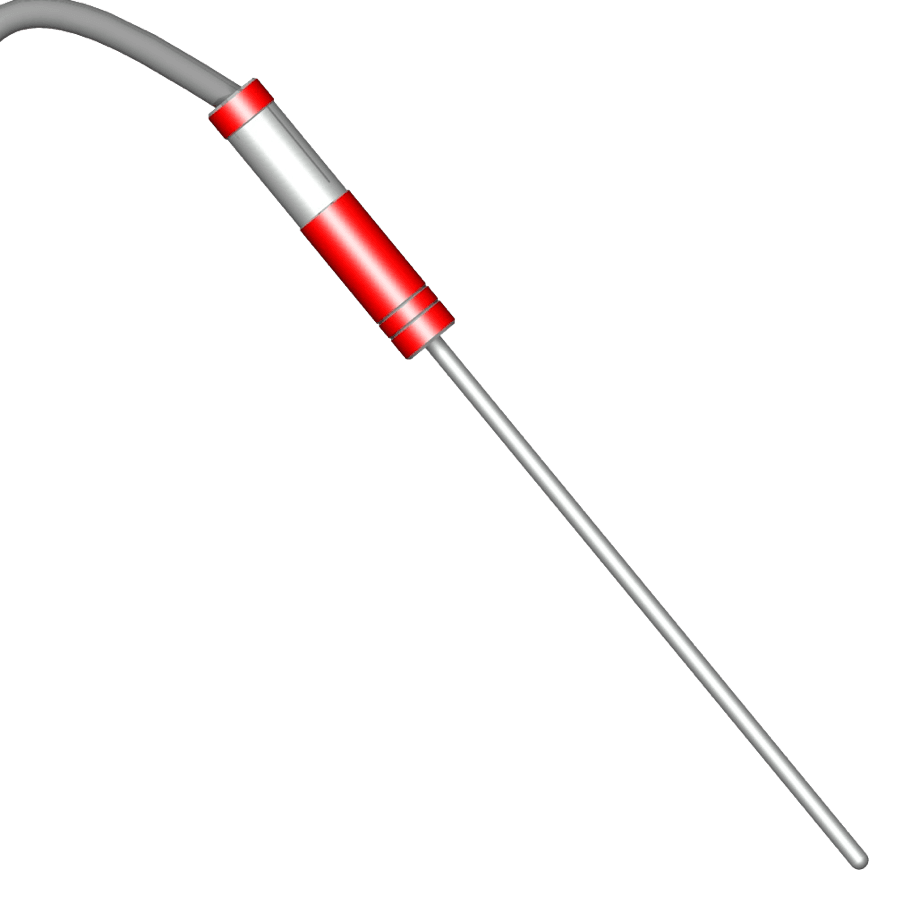
The europascal EP-E164 is a high-precision industrial reference thermometer designed for accurate temperature measurement and professional temperature calibration applications.
With a temperature range from −100 °C to +250 °C, a highly stable 1/10 DIN Pt100 sensor and a typical annual drift of only 2.5 mK, the europascal EP-E164 provides reliable performance for demanding industrial and laboratory applications.
Its slim construction and compact handle make it particularly suitable for use in temperature dry block calibrators, liquid calibration baths and other applications where installation space is limited.
The thermometer features a four-wire connection, a high-quality metal sheath and specially manufactured low-EMF connecting wires to minimize electrical measurement errors.
The europascal EP-E164 can be individually configured according to the required probe length, cable length and electrical connection.
For professional temperature calibration and metrological traceability, visit the europascal Calibration Service.
Your Benefits at a Glance
The europascal EP-E164 combines excellent temperature stability with flexible configuration options and professional calibration capabilities.
Its main advantages include:
- Temperature range from −100 °C to +250 °C
- High-precision 1/10 DIN Pt100 sensor
- Nominal resistance of 100 Ω at 0 °C
- Typical annual drift of only 2.5 mK
- Four-wire resistance measurement
- Highly stable and annealed sensing element
- Slim probe diameter of 4 mm
- Compact handle with a diameter of 12 mm
- Handle length of only 40 mm
- Low-EMF connecting wires
- High-quality metal sheath
- Silver internal thermometer wires
- Individually configurable probe length
- Configurable connection cable
- Different electrical connection options
- Recommended measuring current of 1 mA
- Self-heating contribution of 4 mK
- Suitable for temperature dry block calibrators
- Suitable for liquid calibration baths
- DAkkS-accredited calibration available
- Comparison calibration uncertainties from 10 mK to 40 mK, depending on calibration conditions
Wide Temperature Range from −100 °C to +250 °C
The europascal EP-E164 provides a temperature measurement range of:
−100 °C to +250 °C
This wide temperature range makes the reference thermometer suitable for numerous industrial and laboratory applications.
Typical calibration temperatures include:
- −100 °C
- −80 °C
- −50 °C
- 0 °C
- +25 °C
- +50 °C
- +100 °C
- +150 °C
- +200 °C
- +250 °C
The thermometer can be used as a reference standard when calibrating industrial temperature sensors.
It is particularly suitable for applications requiring accurate temperature measurements over a wide temperature range.
The Pt100 sensing element provides a predictable resistance-temperature relationship, allowing the temperature to be determined using a suitable precision resistance thermometer readout.
High-Precision 1/10 DIN Pt100 Sensor
The europascal EP-E164 uses a high-quality platinum resistance temperature detector.
The sensor is designed according to:
IEC 60751:2008
The nominal resistance is:
100 Ω at 0 °C
The manufacturer specifies a resistance value of:
R₀ = 100 Ω ±0.05 Ω
The temperature coefficient is:
α = 0.003850 ±0.000005
The sensor tolerance is specified as:
1/10 DIN
This tolerance classification describes the resistance thermometer’s conformity to the specified characteristic.
For high-accuracy applications, the individual calibration results and corresponding resistance-temperature relationship should be used.
The thermometer is therefore suitable for precise comparison measurements and industrial temperature calibration.
Excellent Long-Term Stability
The europascal EP-E164 is designed for excellent long-term temperature measurement stability.
The manufacturer specifies a typical annual drift of:
2.5 mK
This corresponds to:
0.0025 °C per year
The low drift is achieved through the use of highly stable and annealed platinum resistance detectors.
Long-term stability is particularly important for reference thermometers used in calibration laboratories.
A stable reference thermometer helps reduce the risk of measurement deviations between calibration intervals.
Actual drift depends on operating conditions, temperature exposure, mechanical stress and handling.
Regular recalibration is recommended to verify the thermometer’s long-term performance.
Four-Wire Resistance Measurement
The europascal EP-E164 features a four-wire electrical connection.
Four-wire measurement is particularly important for precision resistance thermometers.
In a conventional two-wire measurement, the resistance of the connecting cables contributes directly to the measured resistance.
This can cause significant temperature measurement errors.
The four-wire method separates the current supply connections from the voltage measurement connections.
This allows the resistance of the sensing element to be measured with substantially reduced influence from the connecting cables.
The result is improved measurement accuracy, especially when long connection cables are used.
A compatible precision thermometer readout with four-wire measurement capability is required.
Low-EMF Connecting Wires
The europascal EP-E164 uses specially manufactured connecting wires designed to minimize thermoelectric voltages.
These low-EMF stranded wires are produced specifically for precision temperature measurement applications.
Thermoelectric voltages can occur at electrical junctions between different materials when temperature differences are present.
Such voltages may introduce errors during precision resistance measurements.
The use of suitable connecting materials helps reduce these unwanted effects.
This is particularly important when measuring very small resistance changes corresponding to temperature differences of only a few millikelvin.
Slim Probe Design
The europascal EP-E164 features a slim and compact construction.
The probe diameter is:
4 mm
The handle dimensions are:
12 mm diameter × 40 mm length
The compact handle allows the thermometer to be used in confined spaces.
This is especially useful when calibrating temperature dry block calibrators.
Conventional reference thermometers often have larger handles that can interfere with surrounding sensors or calibration equipment.
The slim design of the europascal EP-E164 helps overcome these limitations.
It also allows convenient positioning in calibration inserts and temperature measurement systems.
Ideal for Dry Block Calibrators
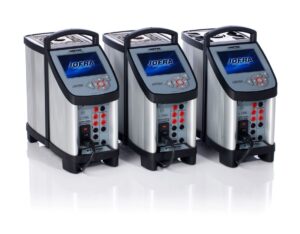
The europascal EP-E164 is particularly suitable for use as a reference thermometer in dry block temperature calibrators.
Dry block calibrators generate controlled temperatures using a heated or cooled metal block.
The reference thermometer measures the actual temperature inside the calibration insert.
This allows the temperature indication of the calibrator to be verified independently.
The europascal EP-E164 can also be used for comparison calibration of other temperature sensors.
Its slim design makes it suitable for calibration inserts with limited space.
For demanding calibration applications, the reference thermometer should be positioned close to the sensing element of the device under test.
Sufficient immersion depth and thermal stabilization must be ensured.
Suitable for Liquid Calibration Baths
The europascal EP-E164 can also be used in liquid temperature calibration baths, provided the selected configuration and materials are suitable for the application.
Liquid calibration baths provide a temperature-controlled environment for accurate comparison measurements.
The reference thermometer is immersed in the calibration liquid together with the temperature sensors being calibrated.
The actual bath temperature is determined using the reference thermometer.
The temperature indications of the devices under test can then be compared with the reference value.
For accurate results, the immersion depth, temperature stability and temperature distribution within the bath must be considered.
Individually Configurable Design
The europascal EP-E164 can be configured according to individual customer requirements.
Available configuration parameters include:
Probe length: Depending on the application.
Connection cable length: Individually configurable.
Electrical connection: Depending on the selected configuration.
This flexibility allows the thermometer to be adapted to different measurement systems and calibration setups.
For example, a longer probe may be required for calibration baths, while a shorter configuration may be more suitable for compact dry block calibrators.
The appropriate configuration should be selected according to the required immersion depth, operating temperature and measurement environment.
europascal can assist customers in selecting the appropriate configuration.
Recommended Measuring Current
The manufacturer specifies a recommended measuring current of:
1 mA
The measuring current is supplied by the connected resistance thermometer readout.
A current flowing through the Pt100 sensing element produces a small amount of electrical power.
This power can cause the sensor temperature to rise slightly above the surrounding temperature.
The effect is known as self-heating.
Using the recommended measuring current helps achieve reproducible measurement conditions.
For high-accuracy temperature calibration, the influence of self-heating must be considered in the measurement uncertainty budget.
Low Self-Heating
The europascal EP-E164 has a specified self-heating value of:
4 mK
This corresponds to:
0.004 °C
Self-heating is an important consideration when using precision platinum resistance thermometers.
The actual temperature increase depends on the measuring current and the thermal conditions surrounding the sensing element.
For example, self-heating may differ between a liquid calibration bath and a dry block calibrator.
The self-heating contribution should therefore be evaluated under the actual measurement conditions.
For demanding calibration applications, measurements at different excitation currents can be used to investigate the self-heating effect.
DAkkS-Accredited Calibration
The europascal EP-E164 can be calibrated in the DAkkS-accredited calibration laboratory of europascal.
Calibration establishes the relationship between the thermometer’s resistance and the corresponding reference temperature.
The manufacturer describes calibration at ITS-90 fixed points as well as comparison calibration in liquid baths and calibration furnaces.
ITS-90 fixed-point calibration provides a direct relationship to defined temperature reference points.
Comparison calibration determines the thermometer’s indication relative to a calibrated reference thermometer.
The appropriate calibration method depends on the required temperature range and measurement uncertainty.
The calibration results provide the basis for using the europascal EP-E164 as a traceable reference thermometer.
Measurement Uncertainty
Measurement uncertainty is an essential consideration when using a reference thermometer.
The europascal EP-E164 is designed for demanding temperature calibration applications.
According to the manufacturer, the major uncertainty contributions include:
- Measurement reproducibility
- ITS-90 resistance-temperature relationship
- Self-heating
- Temperature hysteresis
Additional uncertainty contributions may arise from the thermometer readout, immersion conditions and measurement setup.
For comparison calibration, the datasheet specifies measurement uncertainties ranging from:
10 mK to 40 mK
The actual uncertainty depends on the calibration temperature, method and conditions.
These values must not be interpreted as a universal measurement accuracy specification for every measurement setup.
The uncertainty stated on the individual calibration certificate is decisive for the calibrated thermometer.
Technical Highlights
| Specification | europascal EP-E164 |
|---|---|
| Manufacturer | europascal |
| Model | EP-E164 |
| Product type | Industrial Reference Thermometer |
| Temperature range | −100 °C to +250 °C |
| Sensor type | Pt100 |
| Nominal resistance | 100 Ω |
| Resistance at 0 °C | 100 Ω ±0.05 Ω |
| Temperature coefficient α | 0.003850 ±0.000005 |
| Standard | IEC 60751:2008 |
| Sensor tolerance | 1/10 DIN |
| Typical annual drift | 2.5 mK |
| Electrical connection | Four-wire |
| Probe diameter | 4 mm |
| Handle diameter | 12 mm |
| Handle length | 40 mm |
| Sensor element length | 6 mm |
| Probe length | Configurable |
| Cable length | Configurable |
| Electrical connector | Depending on configuration |
| Sheath material | Metal |
| Internal thermometer wire | Silver |
| Connection cable | Low-EMF stranded wires |
| Recommended measuring current | 1 mA |
| Self-heating | 4 mK |
| Calibration | DAkkS-accredited calibration available |
| Comparison calibration uncertainty | 10 mK to 40 mK |
| Typical applications | Dry block calibrators, calibration baths and precision temperature measurement |
Calibration Service by europascal
Accurate temperature measurement requires reliable reference thermometers and regular calibration.
europascal provides professional calibration services for temperature measuring instruments and reference standards.
The europascal EP-E164 can be calibrated using suitable temperature reference standards.
Depending on the application, calibration can be performed at ITS-90 fixed points or by comparison with calibrated reference thermometers.
For demanding applications, the complete measurement uncertainty must be evaluated.
Relevant contributions include the calibration uncertainty of the reference thermometer, readout uncertainty, self-heating, immersion effects and measurement repeatability.
The appropriate calibration interval depends on the required accuracy, operating conditions and historical stability of the thermometer.
For professional calibration services and metrological traceability, visit the europascal Calibration Service.
Why Choose the europascal EP-E164?
The europascal EP-E164 combines excellent long-term stability, precise temperature measurement and a compact industrial design.
Its temperature range from −100 °C to +250 °C covers numerous laboratory and industrial applications.
The highly stable 1/10 DIN Pt100 sensing element provides reliable resistance-temperature characteristics.
A typical annual drift of only 2.5 mK makes the thermometer particularly suitable for use as a temperature reference.
The four-wire connection and low-EMF connecting cables help minimize electrical measurement errors.
Its slim 4 mm probe and compact handle make it ideal for applications with limited installation space.
The configurable design allows the thermometer to be adapted to different calibration systems.
With DAkkS-accredited calibration available through europascal, the EP-E164 is a professional solution for traceable temperature measurement.
Typical Applications for the europascal EP-E164
The europascal EP-E164 is suitable for numerous precision temperature measurement applications.
Typical applications include:
- Reference temperature measurement
- Dry block calibrator verification
- Dry block calibrator calibration
- Liquid calibration bath measurements
- Pt100 calibration
- Pt1000 comparison calibration
- RTD calibration
- Industrial temperature sensor calibration
- Precision temperature measurement
- Calibration laboratory applications
- Temperature metrology
- Industrial quality assurance
- Pharmaceutical manufacturing
- Environmental testing
- Temperature monitoring
- Reference thermometer applications
The combination of high stability, flexible configuration and professional calibration capabilities makes the europascal EP-E164 an excellent choice for demanding industrial temperature measurement applications.