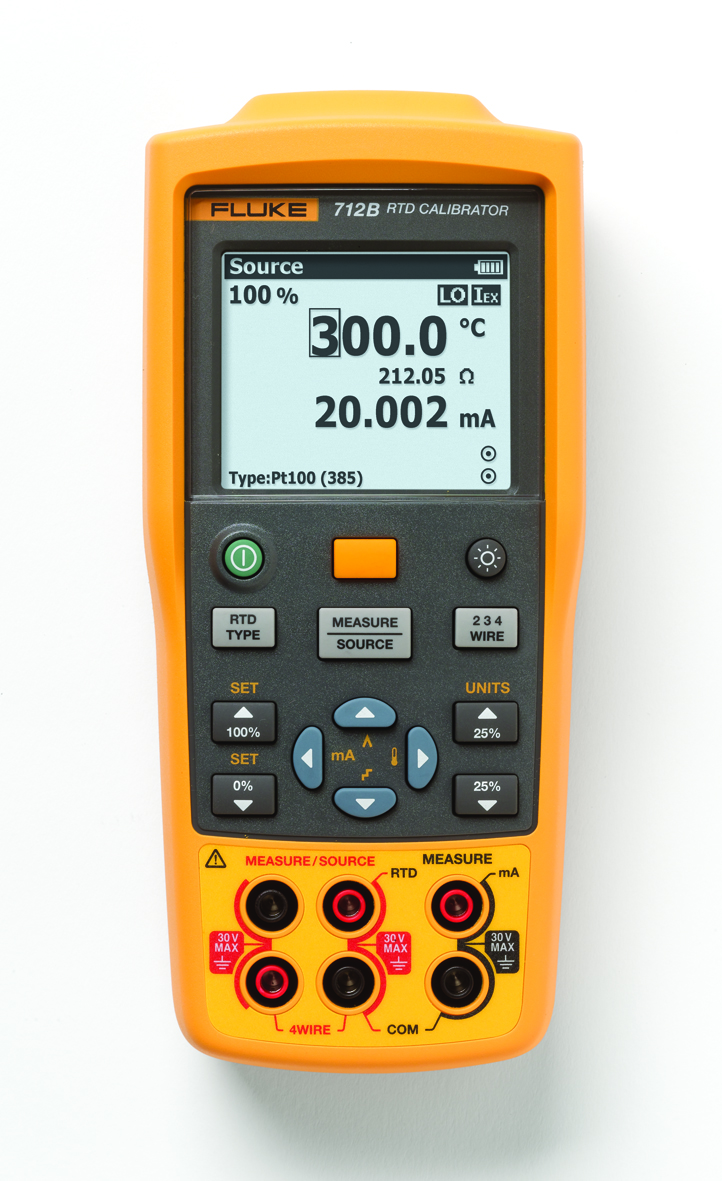
The Fluke Calibration 712B is a precise, portable RTD calibrator designed for measuring and simulating resistance temperature detectors in industrial process applications, calibration laboratories and maintenance environments.
With support for 13 different RTD types, resistance measurement and simulation, and simultaneous 4–20 mA current measurement, the Fluke Calibration 712B provides a versatile solution for temperature instrumentation calibration.
The instrument combines high measurement accuracy with intuitive operation and a compact, battery-powered design. It is particularly suitable for technicians who need to calibrate RTD temperature transmitters, temperature indicators, controllers and other temperature measurement equipment directly in the field.
Unlike temperature calibration baths or dry block calibrators, the Fluke Calibration 712B generates and measures electrical signals corresponding to resistance temperature detectors. This allows temperature instrumentation to be tested without physically generating the corresponding temperature.
The integrated current measurement function enables technicians to verify the output of temperature transmitters while simultaneously simulating an RTD input signal.
Additional features include automatic ramp functions, configurable 0% and 100% output settings, a backlit display and an integrated magnetic hanging accessory.
For professional calibration services and metrological traceability, visit the europascal Calibration Service.
Your Benefits at a Glance
- Measurement and simulation of 13 RTD types
- Precision resistance measurement
- Precision resistance simulation
- Simultaneous 4–20 mA current measurement
- Suitable for Pt100 and Pt1000 applications
- Support for platinum, nickel and copper RTDs
- Configurable 0% and 100% output settings
- Automatic 25% step functions
- Linear ramp functionality
- Support for pulsed temperature transmitters
- Compatible with suitable PLC temperature inputs
- Backlit display
- Compact handheld design
- Battery-powered operation
- Magnetic hanging accessory included
- Automatic recall of previous settings
- One-year and two-year accuracy specifications
- Traceable manufacturer calibration certificate included
- Suitable for industrial temperature transmitter calibration
- Suitable for field service and maintenance
- Professional calibration support from europascal
RTD Measurement and Simulation
The Fluke Calibration 712B provides two essential functions for temperature instrumentation calibration.
RTD measurement allows the instrument to measure the electrical resistance of a connected resistance thermometer and display the corresponding temperature.
RTD simulation allows the instrument to simulate the electrical resistance of a selected RTD type at a specified temperature.
These functions make the Fluke Calibration 712B suitable for checking complete temperature measurement systems.
For example, an industrial temperature transmitter can be disconnected from its Pt100 sensor and connected to the Fluke Calibration 712B.
The calibrator then simulates defined temperatures, allowing the technician to verify the transmitter’s output signal.
This procedure is particularly useful when the actual process temperature cannot be changed during maintenance.
Supports 13 Different RTD Types
The Fluke Calibration 712B supports 13 different resistance temperature detector characteristics.
These include commonly used platinum, nickel and copper resistance thermometers.
Supported sensor characteristics include:
- Pt10
- Pt50
- Pt100
- Pt200
- Pt500
- Pt1000
- Cu10
- Cu50
- Cu100
- Ni120
- YSI400
Different platinum RTD characteristics are supported, including sensors with different temperature coefficients.
This flexibility allows the instrument to be used with numerous industrial temperature measurement systems.
The correct sensor characteristic must be selected before performing a measurement or simulation.
Using an incorrect RTD characteristic can introduce significant temperature errors.
Pt100 Measurement and Simulation
The Fluke Calibration 712B is particularly suitable for Pt100 calibration applications.
Pt100 resistance thermometers are widely used in industrial temperature measurement because of their good stability, repeatability and standardized resistance-temperature relationship.
A standard Pt100 has a nominal resistance of:
100 Ω at 0 °C
The Fluke Calibration 712B can measure the resistance of a connected Pt100 and convert it into temperature.
In simulation mode, the instrument generates the corresponding resistance value for a selected temperature.
This makes it possible to verify temperature transmitters, indicators and controllers without requiring a physical temperature source.
Pt1000 Measurement and Simulation
The Fluke Calibration 712B also supports Pt1000 resistance thermometers.
A Pt1000 has a nominal resistance of:
1000 Ω at 0 °C
Compared with a Pt100, the higher resistance reduces the relative influence of connecting lead resistance.
Pt1000 sensors are frequently used in industrial automation, building technology and process instrumentation.
The Fluke Calibration 712B allows technicians to measure and simulate compatible Pt1000 characteristics.
Precision Resistance Measurement
In addition to displaying temperature, the Fluke Calibration 712B can measure electrical resistance directly.
The resistance measurement range extends from:
0 Ω to 4000 Ω
The manufacturer specifies the following one-year measurement accuracy values.
| Resistance Range | Accuracy |
|---|---|
| 0.00 Ω to 400.00 Ω | ±(0.015% of reading + 0.05 Ω) |
| 400.0 Ω to 4000.0 Ω | ±(0.015% of reading + 0.5 Ω) |
These specifications apply to four-wire resistance measurements under the specified reference conditions.
For three-wire measurements, additional uncertainty contributions must be considered.
The resistance measurement function can also be used to check compatible resistive components and sensor circuits.
Precision Resistance Simulation
The Fluke Calibration 712B can simulate electrical resistance values.
This function is particularly useful when testing RTD temperature transmitters and controllers.
The resistance simulation function covers:
1 Ω to 4000 Ω
The accuracy depends on the selected resistance range and the excitation current supplied by the connected instrument.
For reliable results, the excitation current must remain within the manufacturer’s specified limits.
The Fluke Calibration 712B also supports instruments using pulsed excitation currents.
This makes it suitable for many modern industrial temperature measurement systems.
Simultaneous 4–20 mA Measurement
One of the most useful features of the Fluke Calibration 712B is its ability to measure current while simultaneously simulating an RTD signal.
The instrument provides an isolated current measurement channel.
The current measurement range is:
0 mA to 24 mA
The resolution is:
0.001 mA
The specified accuracy is:
±(0.010% of reading + 2 µA)
This makes the instrument particularly suitable for checking industrial temperature transmitters with 4–20 mA outputs.
For example, a temperature transmitter configured for 0 °C to 100 °C can be tested at several simulated temperatures.
The Fluke Calibration 712B generates the corresponding RTD resistance while measuring the transmitter output current.
This allows the entire electrical conversion process to be evaluated.
Calibration of Temperature Transmitters
Temperature transmitters convert sensor signals into standardized electrical output signals.
A common output range is:
4 mA to 20 mA
The Fluke Calibration 712B allows technicians to simulate a resistance thermometer and simultaneously measure the resulting transmitter current.
For a transmitter configured from 0 °C to 100 °C, typical test points are:
| Simulated Temperature | Expected Output |
|---|---|
| 0 °C | 4 mA |
| 25 °C | 8 mA |
| 50 °C | 12 mA |
| 75 °C | 16 mA |
| 100 °C | 20 mA |
This example assumes a linear transmitter output over the configured temperature range.
The measured current can be compared with the expected value to determine the transmitter error.
This procedure is suitable for routine calibration, commissioning and troubleshooting.
Configurable 0% and 100% Settings
The Fluke Calibration 712B allows users to define the lower and upper limits of a calibration range.
These settings are identified as:
0%
and
100%
Once the limits have been configured, the instrument can generate intermediate test points.
This simplifies calibration procedures involving standardized measurement ranges.
For example, a temperature transmitter configured for 0 °C to 200 °C can be tested at:
- 0 °C
- 50 °C
- 100 °C
- 150 °C
- 200 °C
The configurable output limits reduce the need to enter each temperature manually.
Automatic 25% Step Function
The Fluke Calibration 712B provides an automatic step function.
The instrument can generate output values in:
25% increments
This allows technicians to perform standardized five-point calibration procedures.
The function is particularly useful when testing temperature transmitters and indicators.
By automatically generating defined test points, the calibrator simplifies routine calibration work.
The measured output values can be documented and evaluated according to the required calibration procedure.
Linear Ramp Function
The Fluke Calibration 712B also provides a linear ramp function.
This function changes the simulated temperature continuously between configured limits.
Linear ramps are useful for checking the response of temperature indicators, controllers and transmitters.
They can also be used to evaluate switching points and general response behavior.
The ramp function is based on the configured 0% and 100% output settings.
Support for Pulsed RTD Excitation
Some temperature transmitters and PLC input modules use pulsed excitation currents to measure resistance temperature detectors.
The Fluke Calibration 712B supports pulsed excitation signals with pulse durations as short as:
5 ms
This feature improves compatibility with modern industrial temperature measurement systems.
When simulating RTDs, the excitation current and pulse characteristics of the connected instrument must remain within the specified operating limits.
Two-Wire, Three-Wire and Four-Wire Measurements
The Fluke Calibration 712B supports different resistance measurement configurations.
Two-Wire Measurement
Two-wire measurement uses the same conductors for current supply and voltage measurement.
The resistance of the connecting leads contributes to the measurement result.
This configuration is commonly used in less demanding industrial applications.
Three-Wire Measurement
Three-wire measurement provides compensation for connecting lead resistance.
The compensation assumes that the relevant lead resistances are approximately equal.
This configuration is widely used in industrial Pt100 installations.
Four-Wire Measurement
Four-wire measurement separates the current-carrying and voltage-sensing connections.
This minimizes the influence of connecting lead resistance.
Four-wire measurement is preferred for demanding resistance and RTD measurements.
The manufacturer’s best resistance measurement accuracy specifications are based on four-wire operation.
Compact Handheld Design
The Fluke Calibration 712B is designed for portable use.
Its dimensions are approximately:
188.5 × 84 × 52.5 mm
The instrument weighs approximately:
515 g
The compact design makes it suitable for use in industrial facilities, production environments and calibration laboratories.
The handheld construction allows technicians to perform measurements directly at the installation location.
Battery-Powered Operation
The Fluke Calibration 712B operates using:
Four AA batteries
Battery operation makes the instrument independent of external power supplies during field measurements.
This is particularly useful when calibrating temperature transmitters installed in production facilities.
The instrument also remembers its settings when switched off.
This allows technicians to continue calibration work without repeatedly configuring the same parameters.
Backlit Display
The Fluke Calibration 712B features a backlit display.
The display allows measurement values and simulation settings to be read clearly.
This is particularly useful in industrial environments with limited lighting.
The dual-input arrangement supports convenient operation when measuring transmitter current while generating an RTD simulation signal.
Magnetic Hanging Accessory
The Fluke Calibration 712B includes a magnetic hanging accessory.
This allows the instrument to be attached to suitable metal surfaces.
Hands-free operation is particularly useful when connecting test leads, adjusting transmitters or documenting calibration results.
The magnetic accessory helps improve convenience during field calibration.
Robust Industrial Construction
The Fluke Calibration 712B is designed for demanding industrial environments.
The manufacturer specifies a protection rating of:
IP52
The instrument is suitable for operation at ambient temperatures from:
−10 °C to +50 °C
The construction is designed to withstand normal industrial handling.
The maximum voltage between terminals or between a terminal and earth ground is:
30 V
The specified electrical safety limits must always be observed.
Technical Highlights
| Specification | Fluke Calibration 712B |
|---|---|
| Manufacturer | Fluke |
| Model | 712B |
| Product type | RTD Calibrator |
| RTD characteristics | 13 |
| RTD measurement | Yes |
| RTD simulation | Yes |
| Resistance measurement | 0–4000 Ω |
| Resistance simulation | 1–4000 Ω |
| Current measurement | 0–24 mA |
| Current resolution | 0.001 mA |
| Current accuracy | ±(0.010% of reading + 2 µA) |
| Resistance measurement accuracy, 0–400 Ω | ±(0.015% + 0.05 Ω) |
| Resistance measurement accuracy, 400–4000 Ω | ±(0.015% + 0.5 Ω) |
| Simultaneous RTD simulation and mA measurement | Yes |
| Automatic step function | 25% increments |
| Linear ramp function | Yes |
| Configurable 0% and 100% settings | Yes |
| Pulsed excitation support | From 5 ms |
| Display | Backlit |
| Magnetic hanging accessory | Included |
| Power supply | 4 AA batteries |
| Operating temperature | −10 °C to +50 °C |
| Storage temperature | −30 °C to +60 °C |
| Protection rating | IP52 |
| Maximum terminal voltage | 30 V |
| Dimensions | 188.5 × 84 × 52.5 mm |
| Weight | 515 g |
| Calibration certificate | Traceable manufacturer certificate included |
Fluke Calibration 712B or 714B?
The Fluke Calibration 712B and Fluke Calibration 714B are both portable temperature calibrators.
However, they are designed for different sensor technologies.
The Fluke Calibration 712B is optimized for resistance temperature detectors.
It measures and simulates RTD characteristics and electrical resistance.
The Fluke Calibration 714B is designed for thermocouple calibration.
It measures and simulates thermocouple signals.
Both instruments support simultaneous current measurement for checking temperature transmitters.
Choose the Fluke Calibration 712B when calibrating Pt100, Pt1000 and other RTD-based temperature instrumentation.
Choose the Fluke Calibration 714B when working primarily with thermocouples.
Calibration Service by europascal
Regular calibration is essential for maintaining reliable and traceable temperature measurements.
europascal provides professional calibration services for electrical and temperature measuring instruments.
When the Fluke Calibration 712B is used for RTD simulation, the relevant resistance or temperature simulation accuracy must be considered.
For transmitter calibration, the uncertainty of the simulated RTD signal and the uncertainty of the current measurement must be included in the overall measurement uncertainty evaluation.
The uncertainty contributions depend on the selected RTD type, temperature range and measurement configuration.
For professional calibration services and metrological traceability, visit the europascal Calibration Service.
Why Choose the Fluke Calibration 712B?
The Fluke Calibration 712B combines precise RTD measurement and simulation with convenient handheld operation.
Support for 13 different RTD characteristics makes it suitable for a wide variety of industrial temperature measurement systems.
The integrated resistance measurement and simulation functions provide additional flexibility.
Simultaneous 4–20 mA measurement allows temperature transmitters to be tested efficiently without requiring a separate current meter.
Automatic 25% step functions and linear ramps simplify routine calibration procedures.
The compact, battery-powered construction and magnetic hanging accessory make the instrument particularly suitable for field service applications.
A backlit display and automatic recall of previous settings improve everyday usability.
For calibration technicians, maintenance engineers and industrial users requiring a precise and portable RTD calibrator, the Fluke Calibration 712B provides an excellent combination of functionality, accuracy and convenience.
europascal supports customers with professional calibration equipment, technical advice and calibration services.
Typical Applications for the Fluke Calibration 712B
Typical applications include:
- Pt100 calibration
- Pt1000 calibration
- RTD measurement
- RTD simulation
- Resistance measurement
- Resistance simulation
- Temperature transmitter calibration
- 4–20 mA transmitter testing
- Temperature indicator verification
- Temperature controller testing
- PLC temperature input testing
- Industrial process instrumentation
- Preventive maintenance
- Commissioning
- Field calibration
- Calibration laboratories
- Industrial quality assurance
The combination of accurate RTD measurement, resistance simulation, integrated current measurement and portable construction makes the Fluke Calibration 712B a professional solution for demanding temperature instrumentation calibration.
Find more Fluke Calibration products here.
Manufacturer information for the Fluke Calibration 712B can be found on the official Fluke website.