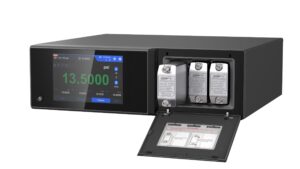
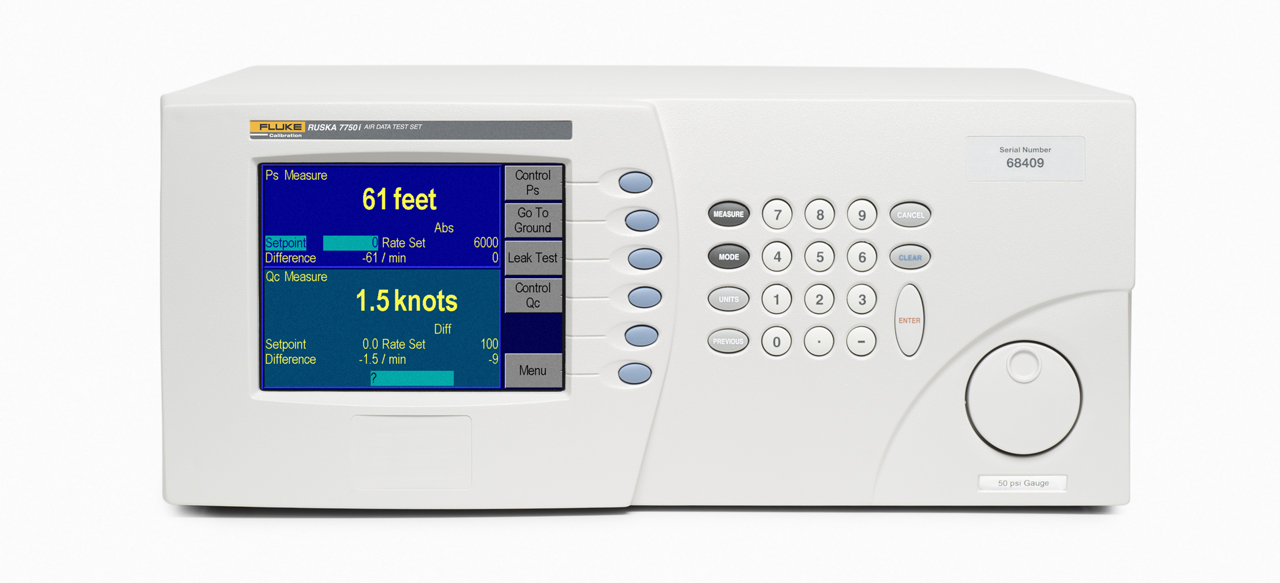
Fluke Calibration 7750i is a precise Air Data Test Set designed for automated testing and calibration of Pitot-static avionics instruments and systems. Engineered for demanding laboratory and aerospace calibration applications, the 7750i automatically measures and controls the pressures required to simulate altitude, airspeed, rate of climb and Mach conditions.
The Fluke Calibration 7750i is suitable for calibrating a wide variety of aviation instruments, including Air Data Computers, altimeters, airspeed indicators, rate-of-climb instruments, Mach meters and other pressure-sensitive avionics equipment.
Advanced quartz pressure sensor technology provides excellent precision and long-term stability. The instrument uses separate absolute and true differential pressure measurement for static pressure Ps and differential pressure Qc. This architecture provides high-performance airspeed and altitude calibration and makes the 7750i suitable for demanding RVSM-related calibration applications.
The standard configuration provides a Ps range of 32 inHg absolute and a Qc range of 68 inHg differential. Additional configurations are available with Ps ranges up to 40 inHg absolute and Qc ranges of 32 or 68 inHg differential, allowing the system to be optimized for fixed-wing or rotary-wing aircraft applications.
Automated pressure control, programmable DUT protection limits, leak testing, automatic volume characterization and automatic zeroing simplify complex air data calibration procedures. The Fluke Calibration 7750i can also be integrated into Automatic Test Equipment using RS232 and IEEE-488.2 communication interfaces.
At europascal, the Fluke Calibration 7750i can be integrated into professional air data and pressure calibration systems. For calibration and metrological traceability, visit the europascal Calibration Service.
Your Benefits at a Glance
The Fluke Calibration 7750i combines precision pressure measurement, automatic pressure control and dedicated air data functions in one professional laboratory instrument.
Key benefits include:
- Professional Air Data Test Set
- Automated Pitot-static testing
- Quartz pressure sensor technology
- Absolute pressure measurement for Ps
- True differential pressure measurement for Qc
- Altitude simulation and calibration
- Airspeed simulation and calibration
- Rate-of-climb control
- Mach measurement and control
- Suitable for RVSM calibration applications
- Precision of 0.005% of reading in the specified upper range
- Excellent long-term stability
- Automatic pressure control
- Automatic Go to Ground
- Automatic volume characterization
- Automatic zeroing
- Dedicated leak test mode
- Programmable DUT protection
- Fixed-wing aircraft configurations
- Rotary-wing aircraft configurations
- 6.4-inch TFT color display
- Multiple aeronautical units
- Multiple engineering pressure units
- RS232 interface
- IEEE-488.2 interface
- SCPI command syntax
- Model 6610 emulation mode
- Suitable for ATE systems
- Optional ISO 17025 accredited calibration
- Recommended one-year calibration interval
Air Data Calibration
The Fluke Calibration 7750i was developed specifically for:
Air Data Calibration.
Aircraft determine important flight parameters from Pitot and static pressures.
The static pressure:
Ps
is used primarily for altitude determination.
The difference between total pressure and static pressure:
Qc
is used to determine airspeed.
By precisely generating and controlling these pressures, the 7750i can simulate defined flight conditions in the calibration laboratory.
Automated Pitot-Static Testing
The Fluke Calibration 7750i automatically controls the pressures required to test Pitot-static avionics instruments.
Typical devices under test include:
- Air Data Computers
- Altimeters
- Airspeed indicators
- Rate-of-climb indicators
- Mach meters
- Cabin pressure instruments
- Air data systems
- Other Pitot-static avionics components
This allows complex air data calibration procedures to be performed under controlled laboratory conditions.
Quartz Sensor Technology
The Fluke Calibration 7750i uses high-performance quartz pressure sensor technology.
Quartz sensors provide excellent precision, repeatability and long-term stability.
The instrument combines an absolute pressure sensor for static pressure with a true differential pressure sensor for airspeed-related measurements.
This is particularly important for precise Qc measurement at lower airspeeds.
Ps Static Pressure
The static pressure channel:
Ps
represents the atmospheric static pressure experienced by the aircraft.
The standard configuration provides a Ps range of:
32 inHg absolute.
This corresponds to approximately:
1,085 mbar absolute.
An alternative configuration provides:
40 inHg absolute
or approximately:
1,355 mbar absolute.
By controlling Ps, the 7750i can simulate different altitude conditions.
Qc Differential Pressure
The:
Qc
channel represents the differential pressure used for airspeed determination.
The standard configuration provides:
68 inHg differential
or approximately:
2,300 mbar differential.
A lower:
32 inHg differential
range is also available.
The 32 inHg Qc configuration can provide improved performance for applications focused on lower airspeeds, such as rotary-wing aircraft.
Altitude Calibration
The Fluke Calibration 7750i can directly control and display altitude.
Altitude can be displayed in:
- Feet
- Meters
This allows altimeters and Air Data Computers to be tested directly using familiar aeronautical units instead of requiring the operator to manually convert pressure values into altitude.
Airspeed Calibration
Airspeed can be displayed and controlled in:
- Knots
- km/h
- Mach
The use of a true differential pressure sensor for Qc provides excellent performance for airspeed calibration.
Depending on range and operating point, Fluke specifies total airspeed uncertainty down to only a few hundredths of a knot.
RVSM Calibration
The Fluke Calibration 7750i is designed for the precision required in demanding aviation calibration applications, including:
Reduced Vertical Separation Minimum – RVSM.
Accurate altitude measurement is essential for aircraft operating under RVSM requirements.
The precision and stability of the 7750i make it suitable for laboratories calibrating instruments and systems used in these applications.
Precision
Fluke specifies pressure measurement precision of:
±0.005% of reading
over the specified upper portion of the pressure range.
At lower pressures, the specification is based on a defined percentage of the sensor full-scale range.
The exact measurement performance depends on the selected Ps and Qc sensor ranges and the operating point.
Long-Term Stability
Long-term stability is an important requirement for laboratory air data calibration equipment.
The Fluke Calibration 7750i provides specified stability for both absolute and differential pressure channels.
Fluke specifies stability values over:
- Three months
- One year
This supports predictable performance between regular calibration intervals.
Automatic Pressure Control
Unlike a reference pressure monitor, the Fluke Calibration 7750i does not simply measure pressure.
It:
automatically generates, controls and measures the required air data pressures when connected to the necessary pressure and vacuum supplies.
This makes the 7750i a complete Air Data Test Set rather than a passive pressure reference.
Automatic Go to Ground
An important safety feature of the Fluke Calibration 7750i is:
Automatic Go to Ground.
When the Go to Ground command is selected, the instrument safely controls the pressure back to the current local barometric pressure.
The device under test can then be disconnected without exposing sensitive avionics equipment to a sudden pressure transient or pressure shock.
DUT Protection
Sensitive avionics instruments can be damaged if unrealistic pressure or flight conditions are applied.
The Fluke Calibration 7750i therefore allows high and low protection limits to be programmed for important parameters.
These include:
- Altitude
- Airspeed
- Rate of climb
- Mach
- Negative Qc
- ARINC 565 envelope
These programmable limits help protect valuable devices under test during automated calibration procedures.
Leak Test Mode
The Fluke Calibration 7750i provides a dedicated:
Leak Test Mode.
Before beginning the actual calibration, the connected Pitot-static system can be checked for leakage.
This is important because leaks in tubing, adapters or the device under test can influence both pressure stability and calibration results.
Automatic Volume Characterization
The 7750i automatically adapts its pressure controller to the connected external volume.
The supported standard load volume is approximately:
80 to 1,000 cm³.
This provides considerable flexibility when connecting different aircraft instruments and test configurations.
Multiple devices can also be connected to a common manifold for suitable production or component-testing applications.
Automatic Zeroing
Regular zeroing helps maintain maximum pressure measurement performance.
The Fluke Calibration 7750i automates this procedure.
Zeroing can be initiated:
- From the instrument
- Through the PC interface
The 7750i incorporates its own vacuum sensor, eliminating the need for an additional external vacuum gauge for the zeroing procedure.
With the specified vacuum equipment, automatic zeroing typically takes approximately:
30 to 45 minutes.
Rate of Climb
The 7750i supports controlled simulation of:
Rate of Climb.
This allows vertical-speed and Air Data Computer functions to be tested under dynamic altitude conditions.
Rate information can be displayed using the corresponding aeronautical units.
Mach Simulation
The Fluke Calibration 7750i also calculates and controls:
Mach.
Programmable limits can be applied to prevent excessive simulated Mach conditions.
This provides an additional layer of DUT protection during automated test sequences.
Fixed-Wing Applications
The standard Fluke Calibration 7750i configuration is well suited to fixed-wing aircraft applications.
The standard ranges are:
Ps: 32 inHg absolute
and:
Qc: 68 inHg differential.
This provides a broad operating range for testing altitude and airspeed instrumentation.
Rotary-Wing Applications
For applications focused on helicopters and other rotary-wing aircraft, Fluke offers a configuration with:
Qc: 32 inHg differential.
The lower Qc range provides enhanced performance at lower airspeeds.
This allows the 7750i to be configured according to the aircraft and avionics systems being tested.
Available Pressure Configurations
The Fluke Calibration 7750i family includes several Ps and Qc combinations.
Available configurations include:
Ps 32 inHg / Qc 68 inHg
Ps 40 inHg / Qc 68 inHg
Ps 32 inHg / Qc 32 inHg
Ps 40 inHg / Qc 32 inHg
The appropriate configuration depends on the aircraft type, maximum altitude, airspeed range and required calibration performance.
6.4-Inch Color Display
The Fluke Calibration 7750i incorporates a:
6.4-inch TFT active-matrix color display.
The display provides clear presentation of pressure and aeronautical parameters.
Typical display resolution includes:
- 1 ft altitude
- 0.1 m altitude
- 0.1 knots
- 0.00001 Mach
This allows important air data parameters to be viewed directly without external conversion.
Aeronautical Units
The 7750i displays common aeronautical units including:
Altitude
- Feet
- Meters
Airspeed
- Knots
- km/h
- Mach
This simplifies operation for technicians working directly with aviation instrumentation.
Engineering Pressure Units
The Fluke Calibration 7750i can also display pressure in common engineering units.
These include:
- inHg
- kPa
- bar
- psi
- inH2O
- kg/cm²
- mmHg
- cmHg
- cmH2O
User-defined linear pressure units are also supported.
Pressure Medium
Fluke specifies the pressure medium as:
high-purity nitrogen
or:
dry, clean air.
Clean pressure media are particularly important for protecting precision pressure sensors, valves and sensitive avionics instruments.
Pressure Supply
The Fluke Calibration 7750i requires an external pressure supply of approximately:
60 psi ±5 psi
or:
4 bar ±0.5 bar.
The pressure supply must provide clean gas suitable for the instrument.
Vacuum Supply
A vacuum source is also required for operation across the complete altitude range.
Fluke specifies a minimum vacuum pump capacity of approximately:
50 liters per minute
with an automatic vent feature.
The specified ultimate vacuum is:
less than 1 mtorr.
Pneumatic Connections
The Fluke Calibration 7750i uses:
1/4 inch FNPT
pneumatic ports.
Adapters for:
AN4
and:
AN6
are supplied.
These connections simplify integration with common aviation and laboratory pressure systems.
IEEE-488.2 Interface
The 7750i provides:
IEEE-488.2 / GPIB
communication.
This allows integration into automated laboratory and Automatic Test Equipment systems.
RS232 Interface
The Fluke Calibration 7750i also includes:
RS232.
This provides another option for remote control and communication with computers and automated calibration systems.
SCPI Commands
The 7750i supports:
SCPI command syntax.
SCPI provides standardized commands for programmable test and measurement instruments.
This makes the 7750i easier to integrate into automated calibration and production test environments.
Model 6610 Emulation
For laboratories upgrading existing air data calibration systems, the Fluke Calibration 7750i provides:
Model 6610 emulation mode.
This backward compatibility can simplify replacement of older Air Data Test Sets without requiring extensive changes to existing automated test software.
Ideal for ATE Systems
The Fluke Calibration 7750i is particularly suitable for:
Automatic Test Equipment – ATE.
Its remote interfaces, programmable protection limits, automated pressure control and compact rack-compatible dimensions make it suitable for integration into automated avionics test environments.
Compact Laboratory Design
The dimensions of the 7750i are approximately:
17.8 × 41.9 × 48.3 cm
or:
7 × 16.5 × 19 inches.
The approximately 7-inch height makes the instrument suitable for integration into laboratory racks and automated test systems.
Weight
The Fluke Calibration 7750i weighs approximately:
20 kg / 45 lb.
Its design is optimized primarily for laboratory and automated test installations rather than handheld field calibration.
Electrical Power
The 7750i operates from an AC power supply.
Depending on configuration, it is designed for international laboratory power systems and has a maximum power consumption of approximately:
150 W.
Operating Environment
The specified operating temperature range is approximately:
18 °C to 36 °C.
The instrument is designed for controlled laboratory environments where its high measurement and control performance can be maintained.
Calibration Interval
Fluke recommends a calibration interval of:
one year.
Regular calibration helps ensure that the 7750i continues to meet its specified pressure and air data performance.
An optional:
ISO 17025 accredited calibration certificate
is available.
Technical Highlights
| Feature | Fluke Calibration 7750i |
|---|---|
| Product type | Air Data Test Set |
| Primary application | Pitot-static avionics calibration |
| Sensor technology | Quartz pressure sensors |
| Static pressure | Ps absolute |
| Airspeed pressure | Qc true differential |
| Standard Ps range | 32 inHg absolute |
| Alternative Ps range | 40 inHg absolute |
| Standard Qc range | 68 inHg differential |
| Alternative Qc range | 32 inHg differential |
| Pressure precision | Up to ±0.005% of reading |
| Altitude units | ft, m |
| Airspeed units | knots, km/h, Mach |
| Display | 6.4-inch TFT color |
| Load volume | 80 to 1,000 cm³ |
| Automatic zeroing | Yes |
| Leak testing | Yes |
| Automatic Go to Ground | Yes |
| DUT protection limits | Yes |
| Pressure supply | 60 psi ±5 psi / 4 bar ±0.5 bar |
| Pressure medium | High-purity nitrogen or dry, clean air |
| IEEE-488.2 | Yes |
| RS232 | Yes |
| SCPI | Yes |
| 6610 emulation | Yes |
| Dimensions | 17.8 × 41.9 × 48.3 cm |
| Weight | Approx. 20 kg |
| Recommended calibration interval | 1 year |
7750i vs. RPM4-AD
The Fluke Calibration 7750i should be distinguished from the older RPM4-AD reference pressure monitor.
The RPM4-AD primarily provides precision measurement of air data pressure parameters.
The 7750i is a complete:
Air Data Test Set.
It provides automated pressure measurement and control for Pitot-static avionics testing.
This makes the 7750i particularly suitable when complete automated simulation of altitude, airspeed and related flight parameters is required.
Typical Applications
The Fluke Calibration 7750i is suitable for:
- Air Data Computer calibration
- Altimeter calibration
- Airspeed indicator calibration
- Rate-of-climb indicator calibration
- Mach meter calibration
- Pitot-static system testing
- Avionics calibration
- RVSM calibration applications
- Aircraft instrumentation calibration
- Fixed-wing aircraft testing
- Rotary-wing aircraft testing
- Cabin pressure instrument testing
- Air data system testing
- Automatic Test Equipment
- Aerospace calibration laboratories
- Avionics manufacturing
- Maintenance and repair organizations
- Research and development
- Pressure metrology
Why Choose the Fluke Calibration 7750i?
The Fluke Calibration 7750i combines precision pressure measurement with fully automated pressure control for professional air data calibration.
Its quartz pressure sensor technology provides the stability and precision required for demanding avionics applications. Separate absolute Ps and true differential Qc measurement enables precise simulation of altitude and airspeed.
The instrument directly displays aeronautical parameters including altitude, airspeed, Mach and rate information, simplifying calibration procedures for Air Data Computers, altimeters, airspeed indicators and other Pitot-static instruments.
Automatic Go to Ground safely returns the system to local atmospheric pressure before a device under test is disconnected. Programmable protection limits for altitude, airspeed, rate of climb, Mach and Qc help protect sensitive avionics equipment.
Automatic volume characterization adapts the controller to external volumes from approximately 80 to 1,000 cm³, while automated zeroing and dedicated leak testing simplify routine laboratory operation.
RS232, IEEE-488.2 and SCPI support enable straightforward integration into automated calibration systems and ATE environments. Model 6610 emulation also supports laboratories upgrading existing air data test installations.
Different Ps and Qc pressure ranges are available for fixed-wing and rotary-wing applications, allowing the system to be configured according to the required aircraft and airspeed range.
At europascal, the Fluke Calibration 7750i can be integrated with suitable pressure and vacuum supplies, pneumatic accessories and calibration equipment to create a professional air data calibration solution.
For professional calibration and metrological traceability, visit the europascal Calibration Service.