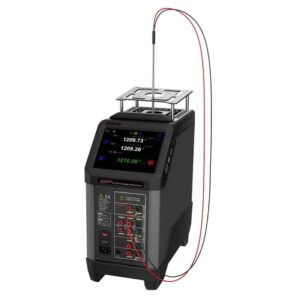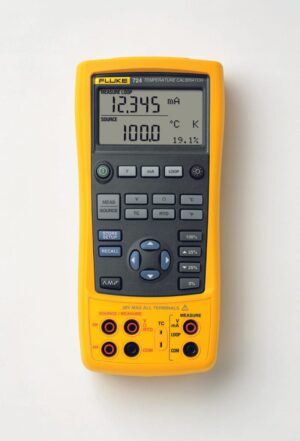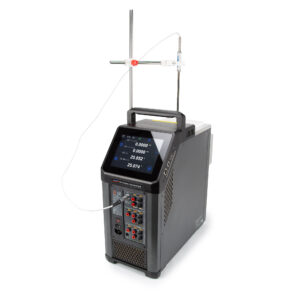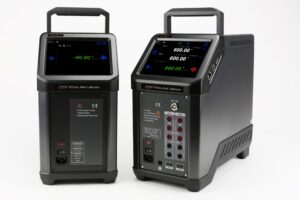
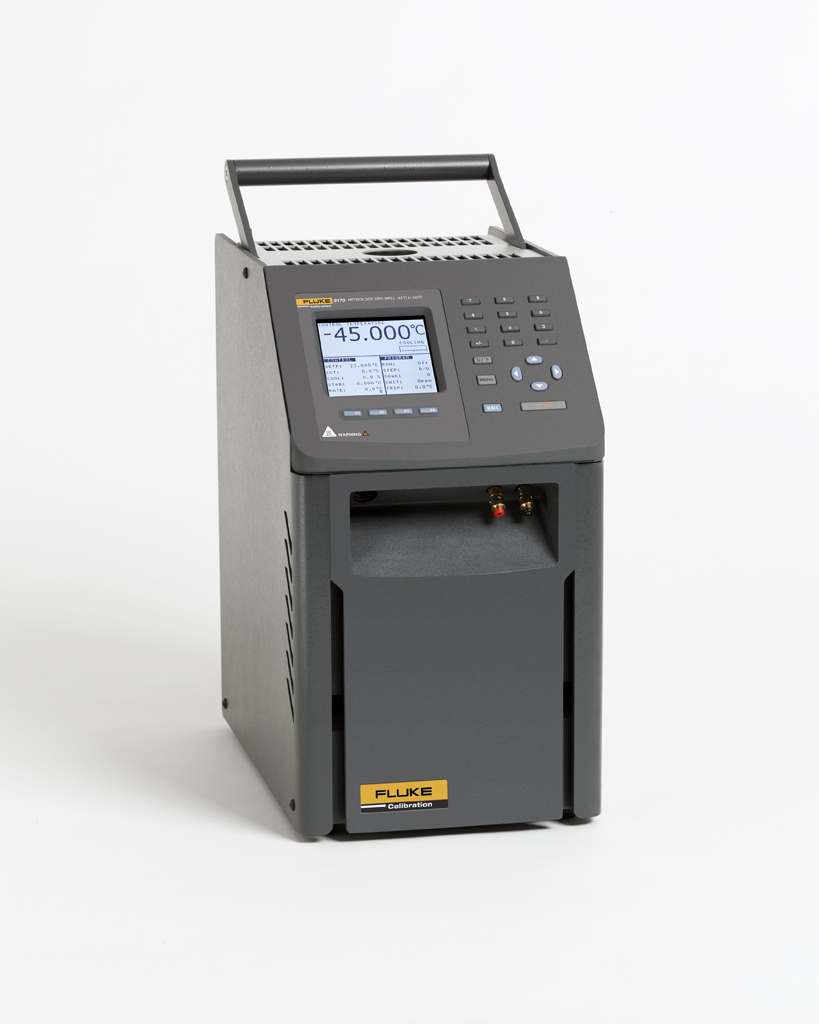
The Fluke Calibration 9170 is a high precision metrology well designed for accurate temperature calibration in professional calibration laboratories, industrial facilities and demanding field applications.
With a temperature range from −45 °C to +140 °C, exceptional temperature stability of ±0.005 °C and a calibrated display accuracy of ±0.1 °C, the Fluke Calibration 9170 provides an excellent solution for calibrating platinum resistance thermometers, resistance temperature detectors, thermistors and other compatible temperature sensors.
The instrument combines the convenience of a portable dry block calibrator with the advanced metrological performance required for demanding temperature calibration applications.
Unlike conventional dry block calibrators, the Fluke Calibration 9170 is designed to minimize temperature gradients, loading effects and hysteresis.
Its advanced temperature control technology provides stable and reproducible calibration conditions.
The instrument features a calibration well depth of 160 mm, helping reduce measurement errors caused by insufficient immersion.
Excellent radial temperature uniformity of ±0.01 °C throughout the operating range makes the Fluke Calibration 9170 particularly suitable for comparison calibration.
An optional integrated reference thermometer input allows direct measurement of compatible platinum resistance thermometers using ITS 90 coefficients.
The Fluke Calibration 9170 also provides programmable calibration procedures, automatic temperature switch testing and an RS232 communication interface.
These capabilities support efficient calibration workflows and integration into automated temperature calibration systems.
europascal offers professional temperature calibration equipment, reference thermometers and technical support for demanding metrological applications.
For professional calibration services and metrological traceability, visit the europascal Calibration Service.
Your Benefits at a Glance
- Temperature range from −45 °C to +140 °C
- Exceptional temperature stability of ±0.005 °C
- Display accuracy of ±0.1 °C throughout the operating range
- Radial temperature uniformity of ±0.01 °C
- Excellent axial temperature uniformity
- Calibration well depth of 160 mm
- Temperature resolution of 0.001 °C
- Low loading effect under specified conditions
- Temperature hysteresis of 0.025 °C
- Optional integrated ITS 90 reference thermometer input
- Support for precision platinum resistance thermometers
- Interchangeable aluminum calibration inserts
- Six standard insert configurations
- Programmable temperature calibration procedures
- Automatic temperature switch testing
- RS232 communication interface
- Compatible with MET/TEMP II calibration software
- Compact construction for laboratory and field applications
- Suitable for low temperature calibration
- Professional calibration support from europascal
Ideal for Demanding Calibration Applications
The Fluke Calibration 9170 is designed for applications requiring excellent temperature stability and well-characterized thermal performance.
Accurate temperature measurements are essential in pharmaceutical production, laboratory testing, industrial manufacturing and quality assurance.
Temperature sensors used in these environments must be calibrated regularly to maintain reliable measurement results.
The Fluke Calibration 9170 provides a controlled temperature environment for comparison calibration of temperature sensors.
Its operating range from −45 °C to +140 °C covers many important low and medium temperature applications.
The instrument is particularly suitable for calibrating platinum resistance thermometers used in laboratories and industrial measurement systems.
It can also be used for evaluating temperature sensors installed in refrigeration systems, environmental chambers and process equipment.
For demanding calibration applications, an external calibrated reference thermometer can be used to determine the actual temperature inside the calibration well.
This helps reduce uncertainty contributions associated with the internal temperature indication.
Temperature Range from −45 °C to +140 °C
The Fluke Calibration 9170 provides a temperature range of:
−45 °C to +140 °C
The specified range applies at an ambient temperature of 23 °C.
This makes the instrument particularly suitable for calibration applications requiring temperatures below ambient conditions.
Typical applications include refrigeration systems, temperature chambers, laboratory equipment and industrial temperature monitoring.
The instrument can also generate calibration temperatures above ambient temperature up to +140 °C.
This broad operating range allows multiple calibration points to be covered using a single temperature source.
The actual calibration procedure should be selected according to the operating range and measurement uncertainty requirements of the device under test.
Exceptional Temperature Stability
Temperature stability is one of the most important characteristics of a precision temperature calibrator.
The Fluke Calibration 9170 provides:
±0.005 °C throughout the operating range
This corresponds to a stability specification of only five millikelvin.
Temperature stability describes the temporal fluctuations of the calibration source under defined operating conditions.
Excellent stability helps maintain constant temperature conditions during calibration measurements.
This is particularly important when calibrating high accuracy resistance thermometers.
However, temperature stability must not be confused with the display accuracy or the expanded measurement uncertainty of a calibration.
Accurate Temperature Indication
The Fluke Calibration 9170 features a calibrated temperature display.
The manufacturer specifies:
Display accuracy: ±0.1 °C
This specification applies throughout the operating range.
The internal temperature indication can be used for applications where its accuracy is sufficient.
For demanding comparison calibrations, a calibrated external reference thermometer is recommended.
The reference thermometer measures the temperature at the calibration position.
The temperature indicated by the device under test can then be compared with the reference temperature.
The resulting measurement uncertainty depends on the reference thermometer, thermal conditions and calibration procedure.
Excellent Axial Temperature Uniformity
The Fluke Calibration 9170 provides well-characterized axial temperature uniformity.
The manufacturer specifies:
±0.1 °C at −45 °C
±0.04 °C at −35 °C
±0.02 °C at 0 °C
±0.07 °C at +140 °C
Axial temperature uniformity describes temperature differences along the vertical direction of the calibration well.
Temperature gradients can influence calibration results when sensors have different immersion depths or sensing element positions.
The Fluke Calibration 9170 is designed to minimize these effects.
For accurate comparison calibration, the reference thermometer and device under test should be positioned at suitable and comparable immersion depths.
Excellent Radial Temperature Uniformity
The Fluke Calibration 9170 provides exceptional radial temperature uniformity.
The manufacturer specifies:
±0.01 °C throughout the operating range
Radial uniformity describes temperature differences between measurement positions within the calibration insert.
Good radial uniformity is particularly important when several temperature sensors are calibrated simultaneously.
It helps ensure that the reference thermometer and devices under test are exposed to similar temperatures.
The actual temperature distribution depends on the calibration insert, probe dimensions and thermal loading.
Low Temperature Loading Effect
The Fluke Calibration 9170 provides a low temperature loading effect.
The manufacturer specifies:
±0.02 °C at −45 °C
±0.005 °C at −35 °C
±0.01 °C at +140 °C
These specifications apply under defined conditions using one 6.35 mm reference thermometer and three additional 6.35 mm probes.
The loading effect describes changes in the calibration source temperature caused by inserting additional sensors.
Low loading effects are important for comparison calibration because several sensors may be inserted into the calibration block simultaneously.
The Fluke Calibration 9170 helps maintain stable temperature conditions under the specified loading conditions.
Temperature Hysteresis
Temperature hysteresis is another important characteristic of a precision metrology well.
The Fluke Calibration 9170 has a specified hysteresis value of:
0.025 °C
Hysteresis describes differences in temperature indication depending on whether a calibration temperature is approached from a higher or lower temperature.
This effect can contribute to the measurement uncertainty.
The Fluke Calibration 9170 is designed to minimize hysteresis and provide reproducible calibration conditions.
Calibration Well Depth of 160 mm
The Fluke Calibration 9170 features a calibration well depth of:
160 mm
Sufficient immersion depth is particularly important when calibrating resistance thermometers.
Heat conduction along the thermometer stem can cause differences between the sensing element temperature and the temperature of the calibration block.
The relatively deep calibration well helps reduce these effects.
The required immersion depth depends on the sensor construction, diameter, sensing element length and calibration temperature.
For demanding calibration applications, the influence of immersion depth should be evaluated as part of the measurement uncertainty budget.
Temperature Resolution of 0.001 °C
The Fluke Calibration 9170 provides a temperature display resolution of:
0.001 °C
This corresponds to one millikelvin.
The fine display resolution allows small temperature changes to be observed.
It is particularly useful when monitoring temperature stability and performing precision comparison measurements.
Display resolution must not be confused with temperature accuracy or measurement uncertainty.
Heating and Cooling Performance
The Fluke Calibration 9170 provides efficient heating and cooling performance.
The manufacturer specifies the following typical times.
Cooling from 23 °C to −45 °C: 44 minutes
Cooling from 23 °C to −30 °C: 19 minutes
Cooling from 140 °C to 23 °C: 19 minutes
Heating from 23 °C to 140 °C: 32 minutes
Heating from −45 °C to 140 °C: 45 minutes
These characteristics support calibration procedures involving multiple temperature points.
Actual heating and cooling times depend on operating conditions and thermal loading.
Interchangeable Calibration Inserts
The Fluke Calibration 9170 uses interchangeable aluminum calibration inserts.
Different insert configurations are available for temperature sensors with different diameters.
The manufacturer offers six standard configurations.
Insert A: Mixed imperial calibration openings.
Insert B: Imperial comparison openings.
Insert C: Six openings with a diameter of 6.35 mm.
Insert D: Metric comparison openings.
Insert E: Mixed metric openings with an additional 6.35 mm reference opening.
Insert F: Metric comparison openings with an additional 6.35 mm reference opening.
A blank insert is also available for customized applications.
The appropriate insert should be selected according to the dimensions of the reference thermometer and the devices under test.
A suitable fit between the sensor and insert helps improve thermal contact.
Optional Integrated Reference Thermometer Input
The Fluke Calibration 9170 is available with an optional integrated reference thermometer input.
These versions are identified by the additional R in the model designation.
For example:
Fluke Calibration 9170-A-R
The integrated reference input supports compatible platinum resistance thermometers.
It allows reference temperature measurements using ITS 90 coefficients.
The manufacturer specifies reference readout accuracy down to:
±0.006 °C
under the applicable measurement conditions.
This specification describes the performance of the integrated reference thermometer readout.
It does not include the calibration uncertainty of the connected reference thermometer.
The total measurement uncertainty depends on the readout, reference thermometer and calibration conditions.
Platinum Resistance Thermometer Calibration
The Fluke Calibration 9170 is particularly suitable for calibrating platinum resistance thermometers.
Typical applications include Pt100 sensors, precision platinum resistance thermometers and compatible reference thermometers.
The sensor under test is inserted into a suitable calibration opening.
A calibrated reference thermometer is positioned in another opening.
After thermal stabilization, the temperature indications are compared.
The indication error can be calculated as:
ΔT = T_DUT − T_REF
Where:
ΔT is the temperature indication error.
T_DUT is the temperature indicated by the device under test.
T_REF is the reference temperature.
The measurement uncertainty depends on the reference thermometer, thermal uniformity, stability, loading effect and immersion depth.
Automated Calibration Procedures
The Fluke Calibration 9170 includes programmable calibration functions.
The instrument supports:
Four programmable calibration procedures
Each procedure can contain up to:
Eight temperature setpoints
Individual ramp and hold times can be configured.
These functions help simplify repeated calibration procedures.
The instrument can automatically move between predefined temperature setpoints without requiring continuous manual adjustment.
This is particularly useful when calibrating temperature sensors at several temperatures.
Automatic Temperature Switch Testing
The Fluke Calibration 9170 supports automatic temperature switch testing.
The instrument can determine switching temperatures and the dead band of temperature switches.
Temperature switches are widely used in industrial process control and safety systems.
The automatic test function simplifies the determination of switching characteristics.
This helps improve efficiency during routine maintenance and calibration procedures.
RS232 Communication and Automation
The Fluke Calibration 9170 features an integrated RS232 communication interface.
This allows the instrument to communicate with a computer or compatible calibration software.
The manufacturer specifies compatibility with MET/TEMP II software.
This enables automated calibration procedures for resistance thermometers, thermocouples and thermistors.
Automated calibration can help reduce manual work and improve the consistency of repeated measurements.
The instrument can also be operated independently without a computer.
Technical Highlights
| Specification | Fluke Calibration 9170 |
|---|---|
| Manufacturer | Fluke Calibration |
| Model | 9170 |
| Product type | Metrology Well |
| Temperature range | −45 °C to +140 °C |
| Reference ambient temperature | 23 °C |
| Display accuracy | ±0.1 °C |
| Temperature stability | ±0.005 °C |
| Axial uniformity at −45 °C | ±0.1 °C |
| Axial uniformity at −35 °C | ±0.04 °C |
| Axial uniformity at 0 °C | ±0.02 °C |
| Axial uniformity at 140 °C | ±0.07 °C |
| Radial uniformity | ±0.01 °C |
| Loading effect at −45 °C | ±0.02 °C |
| Loading effect at −35 °C | ±0.005 °C |
| Loading effect at 140 °C | ±0.01 °C |
| Hysteresis | 0.025 °C |
| Temperature resolution | 0.001 °C |
| Calibration well depth | 160 mm |
| Cooling time, 23 °C to −45 °C | 44 minutes |
| Cooling time, 23 °C to −30 °C | 19 minutes |
| Cooling time, 140 °C to 23 °C | 19 minutes |
| Heating time, 23 °C to 140 °C | 32 minutes |
| Heating time, −45 °C to 140 °C | 45 minutes |
| Calibration inserts | A, B, C, D, E, F |
| Optional reference input | Available |
| Reference readout accuracy | Down to ±0.006 °C |
| Programmable procedures | 4 |
| Setpoints per procedure | Up to 8 |
| Temperature switch testing | Integrated |
| Communication interface | RS232 |
| Compatible software | MET/TEMP II |
| Dimensions | 366 × 203 × 323 mm |
Fluke Calibration 9170 or Fluke Calibration 9142?
The Fluke Calibration 9170 and Fluke Calibration 9142 are designed for professional temperature calibration applications.
However, they differ in temperature range and metrological performance.
The Fluke Calibration 9170 operates from −45 °C to +140 °C.
The Fluke Calibration 9142 operates from −25 °C to +150 °C.
The Fluke Calibration 9170 provides temperature stability of ±0.005 °C throughout its operating range.
The Fluke Calibration 9142 provides temperature stability of ±0.01 °C.
The Fluke Calibration 9170 is particularly suitable for demanding low temperature calibration applications requiring excellent temperature stability and low measurement uncertainty.
The Fluke Calibration 9142 offers a compact field calibration solution with optional integrated process measurement electronics.
The appropriate instrument depends on the required temperature range, measurement uncertainty and application requirements.
Calibration Service by europascal
Regular calibration is essential for maintaining reliable temperature measurements.
europascal provides professional calibration services for temperature measuring instruments and calibration equipment.
When calibrating a metrology well, several characteristics must be considered.
These include temperature indication error, stability, axial temperature uniformity, radial temperature uniformity, loading effects and hysteresis.
The overall measurement uncertainty also depends on the reference thermometer and its calibration uncertainty.
For professional calibration services and metrological traceability, visit the europascal Calibration Service.
europascal also supports customers in selecting suitable reference thermometers, calibration inserts and complete temperature calibration systems.
Why Choose the Fluke Calibration 9170?
The Fluke Calibration 9170 combines exceptional temperature stability with a wide low temperature operating range and excellent thermal uniformity.
Its temperature range from −45 °C to +140 °C makes it suitable for numerous industrial and laboratory calibration applications.
Temperature stability of ±0.005 °C provides reproducible calibration conditions.
The calibrated temperature display offers an accuracy of ±0.1 °C throughout the operating range.
Excellent radial temperature uniformity of ±0.01 °C supports accurate comparison calibration.
The 160 mm calibration well depth helps reduce errors caused by insufficient immersion.
Interchangeable calibration inserts allow different sensor diameters to be accommodated.
The optional integrated reference thermometer input provides additional flexibility for high precision temperature measurements.
Programmable calibration procedures, automatic temperature switch testing and RS232 communication support efficient calibration workflows.
For professional calibration laboratories requiring excellent metrological performance at low temperatures, the Fluke Calibration 9170 provides a reliable and versatile solution.
europascal supports customers with temperature calibration equipment, technical advice and professional calibration services.
Typical Calibration Applications with the Fluke Calibration 9170
The Fluke Calibration 9170 is suitable for calibrating platinum resistance thermometers, precision resistance thermometers, industrial RTDs, thermistors and other compatible temperature sensors.
Typical applications include pharmaceutical production, laboratory temperature measurement, industrial process instrumentation, refrigeration systems, environmental chambers, quality assurance and calibration laboratories.
The combination of excellent temperature stability, low temperature capability, well-characterized thermal uniformity and automated calibration functions makes the Fluke Calibration 9170 a professional solution for demanding temperature calibration applications.
Weitere Produkte von Fluke Calibration finden Sie hier.
Herstellerinformationen zum Fluke Calibration 9170 finden Sie auf der offiziellen Webseite von Fluke Calibration.