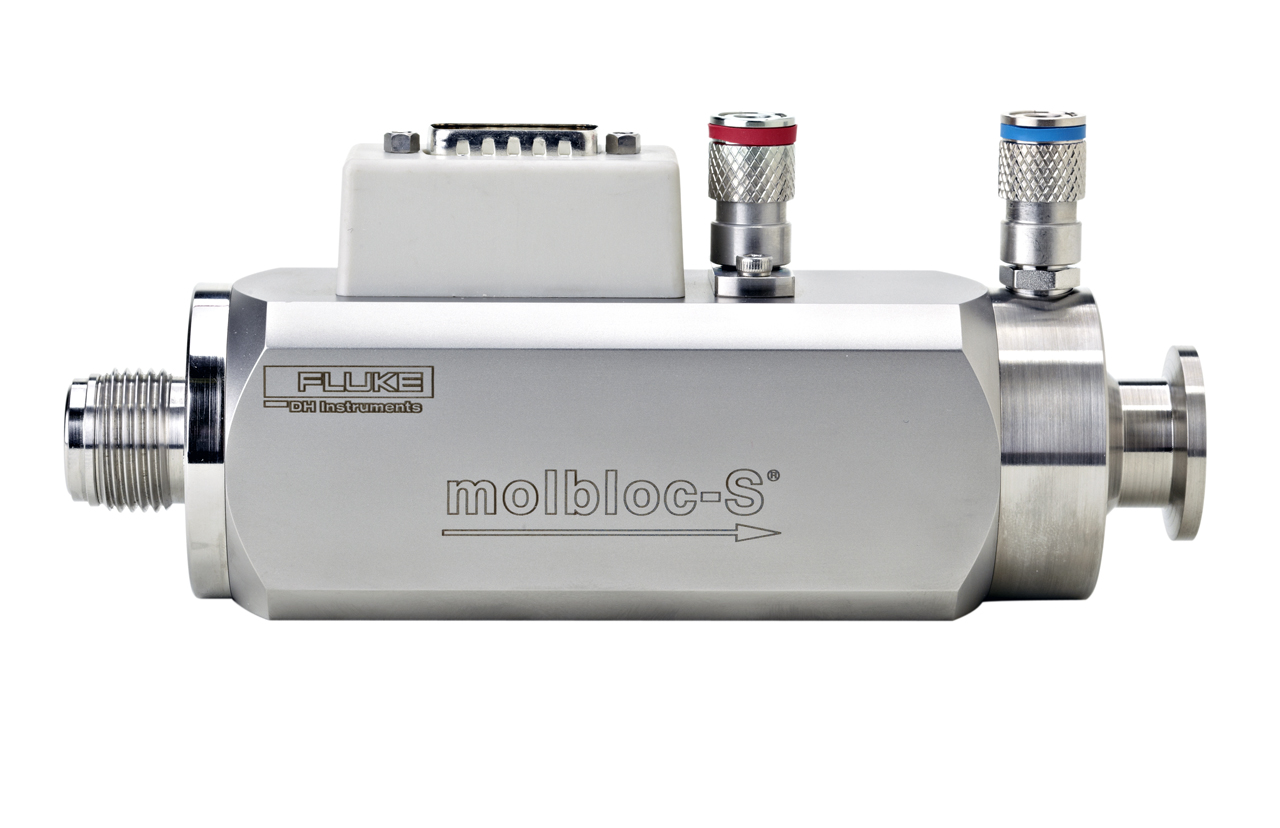
Fluke Calibration molbloc-S is a precise sonic nozzle flow element designed for professional gas mass flow measurement and calibration. Used together with a compatible Fluke Calibration molbox flow terminal, the molbloc-S provides a highly stable reference for calibrating gas flow meters, mass flow meters and mass flow controllers at medium and high gas flow rates.
The molbloc-S operates according to the proven critical flow venturi or sonic nozzle principle. When the required pressure ratio across the nozzle is reached, the gas reaches sonic velocity at the nozzle throat. Under these choked-flow conditions, the mass flow rate is primarily determined by the upstream absolute pressure, gas temperature, nozzle characteristics and gas properties.
This operating principle provides excellent stability and repeatability while minimizing sensitivity to downstream pressure variations within the permitted critical-flow operating range.
Depending on the selected molbloc-S size and operating pressure, the system can cover gas flows extending up to approximately 5,000 slm for air and nitrogen applications. Different molbloc-S sizes can be connected to the same compatible molbox flow terminal, creating a modular calibration system that can be adapted to different flow ranges.
With Premium calibration, the molbloc-S system provides a measurement uncertainty as low as ±0.125% of reading, making it suitable for demanding calibration laboratories, industrial metrology and research applications.
At europascal, the Fluke Calibration molbloc-S complements a comprehensive range of professional flow and calibration equipment. For information about professional calibration and metrological traceability, visit the europascal Calibration Service.
Your Benefits at a Glance
The Fluke Calibration molbloc-S combines the proven sonic nozzle measurement principle with high accuracy, excellent stability and flexible integration into molbloc/molbox calibration systems.
Key advantages include:
- Sonic nozzle flow element for gas mass flow calibration
- Proven critical-flow Venturi nozzle principle
- Gas flow capability up to approximately 5,000 slm depending on model and operating conditions
- Measurement uncertainty down to ±0.125% of reading with Premium calibration
- Standard calibration uncertainty of ±0.2% of reading
- Precision of ±0.06% of reading
- Resolution of 0.0015% FS
- Excellent long-term stability
- Usable range from 10% to 100% of full scale
- Up to 10:1 turndown with appropriate molbox configuration
- Integral gas temperature conditioning and measurement
- Multiple calibration gases available
- Low sensitivity to contamination
- No moving parts
- Continuous real-time flow measurement
- Multiple pressure calibration ranges
- Can be fully automated
- Compatible with Fluke Calibration molbox flow terminals
- Compatible with molbox2 and molbox2-S systems
- Integration with COMPASS for Flow software
- Accredited calibration report included with standard configurations
Critical Flow Sonic Nozzle Principle
The Fluke Calibration molbloc-S uses a critical-flow Venturi nozzle as its fundamental measurement element.
Gas enters the nozzle from the upstream side and accelerates as the cross-sectional area decreases.
At the narrowest point of the nozzle, known as the throat, the gas can reach:
Mach 1
or sonic velocity.
When this condition is reached, the flow is described as:
critical flow
or:
choked flow.
Once the flow is choked, further reductions in downstream pressure do not significantly increase the mass flow through the nozzle.
The mass flow is then primarily determined by:
- Upstream absolute pressure
- Gas temperature
- Nozzle geometry
- Gas properties
This makes the sonic nozzle an excellent transfer standard for gas mass flow calibration.
Mass Flow Proportional to Upstream Pressure
Under critical-flow conditions, the mass flow through a molbloc-S is approximately proportional to the absolute upstream pressure.
Fluke characterizes each molbloc-S using a:
Pressure to Flow Conversion Ratio KF.
The KF value describes the relationship between upstream pressure and mass flow.
Different molbloc-S models provide different KF values.
This enables the appropriate sonic nozzle element to be selected according to the required flow range.
By changing the upstream pressure, the user can vary the mass flow through the molbloc-S while maintaining critical-flow conditions.
Flow Rates up to Approximately 5,000 slm
The Fluke Calibration molbloc-S family is designed to cover medium to high gas flow rates.
Depending on nozzle size, calibration range, gas and operating pressure, molbloc-S elements can cover flow rates extending to approximately:
5,000 slm
for nitrogen and air.
This complements the lower-flow capability of Fluke Calibration molbloc-L laminar flow elements.
A complete molbloc/molbox system can therefore cover an exceptionally broad range of gas flows using interchangeable flow elements.
10:1 Rangeability
A major advantage of the Fluke Calibration molbloc-S is its potential rangeability.
The specified flow measurement range is:
10% to 100% of molbloc full scale.
This corresponds to a potential:
10:1 turndown.
The achievable range depends on the available upstream pressure and required downstream-to-upstream pressure ratio.
When combined with a suitable high-pressure molbox2-S configuration, a molbloc-S can cover a particularly broad flow range without requiring a vacuum pump in many common applications.
Measurement Uncertainty Down to ±0.125%
The Fluke Calibration molbloc-S provides excellent measurement performance for professional gas flow calibration.
With Standard calibration, Fluke specifies measurement uncertainty of:
±0.2% of reading.
With Premium calibration, this improves to:
±0.125% of reading.
The specified precision is:
±0.06% of reading.
Resolution is:
0.0015% of full scale.
These specifications apply over the specified 10% to 100% full-scale operating range and under the corresponding calibration and operating conditions.
Excellent Long-Term Stability
The sonic nozzle principle provides excellent long-term stability because the molbloc-S contains no moving measurement components.
For Standard calibration, Fluke specifies predicted one-year stability of:
±0.05% of reading.
With Premium calibration, the corresponding value is:
±0.03% of reading.
This stability is an important characteristic for calibration laboratories because long-term changes in the reference standard directly influence calibration results and measurement uncertainty.
molbloc-S with Fluke Calibration molbox2
The Fluke Calibration molbloc-S is designed to operate as part of the molbloc/molbox gas flow calibration system.
A modern configuration consists of:
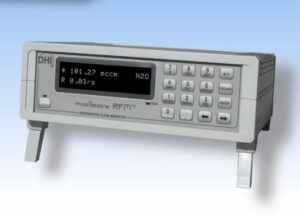
molbloc-S + Fluke Calibration molbox2
The molbloc-S provides the characterized sonic nozzle flow element.
The molbox2 measures the upstream absolute pressure and temperature required for determining the gas mass flow.
The calibration data stored for the molbloc is then used by the flow terminal to calculate and display the corresponding flow value in real time.
This modular design enables different molbloc flow elements to be connected to the same molbox terminal.
molbloc-S with molbox2-S
For maximum rangeability, the Fluke Calibration molbloc-S can be combined with the special:
molbox2-S
flow terminal configuration.
The molbox2-S is specifically optimized for sonic nozzle applications.
It is available with upstream Q-RPT pressure measurement up to:
2 MPa absolute / 300 psia.
The higher upstream pressure capability allows the molbloc-S to operate over a wider flow range when positioned upstream of a device under test operating near atmospheric pressure.
This can provide a full:
10:1 flow turndown
without requiring a vacuum pump in many applications.
Example of Extended Rangeability
Fluke provides practical examples showing the benefit of combining molbloc-S with molbox2-S.
For example, a:
1E2-S
molbloc-S may provide approximately:
15 to 60 slm
with a Standard Pressure calibration and molbox2 A700K when the device under test operates at atmospheric pressure.
With a High Pressure calibration and molbox2-S A2M, the usable range can increase to approximately:
20 to 300 slm.
For a:
5E2-S
element, a typical Standard Pressure configuration provides approximately:
67 to 300 slm.
With High Pressure calibration and molbox2-S, the usable range can extend to approximately:
100 to 1,000 slm.
This expanded rangeability can reduce the number of flow elements required to cover a broad calibration range.
Multiple Pressure Calibration Ranges
The Fluke Calibration molbloc-S can be calibrated for different upstream pressure ranges.
Fluke defines three primary pressure calibration ranges.
Low Pressure – LP
Upstream absolute pressure:
20 to 200 kPa absolute
Standard Pressure – SP
Upstream absolute pressure:
50 to 500 kPa absolute
High Pressure – HP
Upstream absolute pressure:
200 kPa to 2 MPa absolute
The appropriate calibration range depends on the required flow range, system configuration and position of the device under test.
Multiple calibration types can be stored for the same molbloc-S, providing additional flexibility.
Required Back Pressure Ratio
For a sonic nozzle to operate under critical-flow conditions, a sufficient pressure ratio must exist between the upstream and downstream sides.
Fluke specifies a required back-pressure ratio of approximately:
0.4 to 0.9
depending on Reynolds number.
The exact critical pressure ratio depends on operating conditions.
If the downstream pressure becomes too high relative to the upstream pressure, the nozzle leaves the critical-flow condition.
Correct system design must therefore ensure that the required pressure ratio is maintained throughout the intended flow range.
Integral Gas Temperature Conditioning
Accurate gas temperature measurement is essential for determining mass flow through a sonic nozzle.
The Fluke Calibration molbloc-S therefore incorporates gas temperature conditioning and measurement.
The molbox terminal reads the temperature information together with the upstream pressure.
These parameters are combined with the molbloc calibration data and gas properties to determine the mass flow.
This integrated approach supports accurate real-time flow measurement.
Multiple Calibration Gases
The Fluke Calibration molbloc-S can be calibrated for several gases.
Standard calibration is performed using:
dry air.
Optional calibration gases include:
- Nitrogen – N₂
- Argon – Ar
- Hydrogen – H₂
- Helium – He
- Nitrous oxide – N₂O
Additional gases may be available depending on molbloc size and calibration range.
Fluke recommends consultation regarding the availability of specific gas and range combinations.
A dry-air calibration is required for humid-air operation.
Real-Time Gas Flow Measurement
The Fluke Calibration molbloc-S provides continuous real-time flow measurement when used with a compatible molbox terminal.
This is a major practical advantage compared with flow standards that require gas to be collected over a defined time interval.
The operator can directly observe how the device under test responds to changes in gas flow.
This is particularly useful when calibrating:
- Mass flow controllers
- Mass flow meters
- Rotameters
- Variable-area flow meters
- Turbine gas meters
- Process flow instruments
Real-time measurement also simplifies adjustment of analog flow devices.
Calibration of Mass Flow Controllers
One of the most important applications of the Fluke Calibration molbloc-S is calibration of mass flow controllers.
A typical system can consist of:
Gas Supply → molbloc-S → MFC Under Test
with the molbox terminal measuring the upstream conditions at the molbloc-S.
The reference flow calculated by the molbox is compared with the indicated or commanded flow of the mass flow controller.
Depending on the required system configuration, additional pressure regulation, valves and vacuum equipment may be used.
With molbox2-S and a suitable high-pressure calibration, many applications can be performed without a downstream vacuum pump.
Calibration of Gas Flow Meters
The molbloc-S is also suitable for calibration of various gas flow meters.
Typical devices include:
- Thermal mass flow meters
- Mass flow controllers
- Rotameters
- Variable-area flow meters
- Turbine gas meters
- Roots-type gas meters
- Critical flow devices
- Process gas flow meters
- Flow transfer standards
The broad range of available molbloc-S sizes allows a calibration system to be configured for different flow requirements.
Minimal Sensitivity to Contamination
Sonic nozzle flow elements provide good resistance to contamination compared with measurement principles containing small laminar flow passages or moving components.
Fluke highlights the molbloc-S as having:
minimal sensitivity to contamination.
Nevertheless, clean calibration gas should always be used.
Contamination or physical damage to the nozzle geometry can influence the relationship between upstream conditions and mass flow and therefore affect calibration performance.
Appropriate filtration and careful handling remain important for maintaining metrological performance.
No Moving Parts
The Fluke Calibration molbloc-S contains no moving measurement parts.
This provides several advantages:
- Excellent repeatability
- High reliability
- Low mechanical wear
- No mechanical flow fluctuations
- Excellent long-term stability
- Reduced maintenance requirements
This simple and stable measurement principle is particularly valuable for reference standards used repeatedly in professional calibration laboratories.
Traceability to Gravimetric Flow Standards
The performance of the molbloc-S is supported by primary gravimetric calibration.
Fluke Calibration uses gravimetric mass flow measurement as the basis for establishing traceability of its molbloc flow elements.
This provides the metrological foundation for using molbloc-S elements as transfer standards in professional gas flow calibration systems.
Accredited Calibration Report
A new Fluke Calibration molbloc-S is supplied with a standard uncertainty calibration at Standard Pressure using air and an accredited calibration report.
Premium uncertainty calibration is available as an option.
Low Pressure and High Pressure calibrations are also available according to the required application.
Additional gas calibrations can be ordered depending on the selected model and operating range.
This enables the molbloc-S to be configured specifically for the intended calibration task.
molbloc-S Models
Fluke offers several molbloc-S sizes with different pressure-to-flow conversion ratios.
Examples include:
1E1-S – KF 10 sccm/kPa
2E1-S – KF 20 sccm/kPa
5E1-S – KF 50 sccm/kPa
1E2-S – KF 100 sccm/kPa
Additional sizes are available for higher flow ranges.
The correct molbloc-S should be selected according to:
- Required minimum flow
- Required maximum flow
- Gas
- Upstream pressure
- Downstream pressure
- Required calibration uncertainty
- Device-under-test pressure requirements
molbloc-S vs. molbloc-L
The Fluke Calibration molbloc-S and molbloc-L are both interchangeable flow elements for the molbloc/molbox gas flow calibration system, but they use different measurement principles.
The molbloc-S uses a:
critical-flow sonic nozzle.
The molbloc-L uses a:
laminar flow element.
molbloc-L is particularly suitable for lower flow rates and provides continuous operation down to very low percentages of full scale.
molbloc-S is optimized for medium and higher gas flows and operates over approximately:
10% to 100% FS.
The molbloc-S family extends the molbloc/molbox system into flow ranges up to approximately:
5,000 slm.
Both technologies can be used within the same overall Fluke Calibration flow calibration platform.
molbloc-S vs. Critical Nozzle
The molbloc-S is fundamentally a precision critical-flow Venturi nozzle, often also called a sonic nozzle.
However, it is more than an uncharacterized nozzle.
Each molbloc-S is individually calibrated and contains the information required by the compatible molbox terminal to determine mass flow from the measured operating conditions.
The combination of characterized nozzle, integrated temperature measurement, pressure measurement and molbox calculation transforms the sonic nozzle into a professional gas flow transfer standard.
COMPASS for Flow Automation
The Fluke Calibration molbloc-S can be integrated into automated calibration systems using:
COMPASS for Flow.
The software supports automated gas flow calibration procedures in combination with compatible Fluke Calibration hardware.
Depending on system configuration, automation can include:
- Flow point generation
- Pressure control
- Reference flow measurement
- Device-under-test measurement
- Calibration sequence execution
- Data acquisition
- Result processing
- Calibration documentation
This makes molbloc-S suitable for both manually operated calibration benches and highly automated flow calibration laboratories.
Typical Applications
The Fluke Calibration molbloc-S is suitable for:
- Gas mass flow calibration
- High gas flow calibration
- Mass flow controller calibration
- Mass flow meter calibration
- Rotameter calibration
- Variable-area flow meter calibration
- Turbine gas meter calibration
- Process flow meter calibration
- Sonic nozzle calibration systems
- Flow transfer standards
- Semiconductor applications
- Pharmaceutical applications
- Aerospace
- Environmental monitoring
- Energy applications
- Reference gas production
- Research laboratories
- Calibration laboratories
- Gas flow metrology
Why Choose the Fluke Calibration molbloc-S?
The Fluke Calibration molbloc-S combines the inherently stable sonic nozzle principle with individual characterization and integration into the proven Fluke Calibration molbloc/molbox measurement system.
The critical-flow operating principle makes the mass flow primarily dependent on upstream pressure, gas temperature, nozzle geometry and gas properties once sonic conditions have been established.
With Premium calibration, measurement uncertainty can be as low as ±0.125% of reading, while precision is specified at ±0.06% of reading.
The usable measurement range extends from 10% to 100% of the individual molbloc full scale, providing up to 10:1 turndown when suitable pressure conditions are available.
Combined with the modern molbox2-S, molbloc-S elements can operate at upstream pressures up to 2 MPa absolute, significantly extending their usable flow range and reducing or eliminating the need for vacuum pumps in many calibration configurations.
Multiple molbloc-S sizes and calibration pressure ranges allow the system to be adapted to specific gas flow applications.
The result is a highly stable, modular and traceable gas flow standard suitable for demanding industrial and laboratory calibration.
At europascal, we provide Fluke Calibration flow, pressure, temperature and electrical calibration technology for professional laboratory and industrial applications.
For professional calibration and metrological traceability, visit the europascal Calibration Service.
Further products from Fluke Calibration are available from europascal.
Manufacturer information about the Fluke Calibration molbloc-S is available on the official Fluke Calibration website.