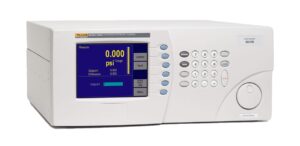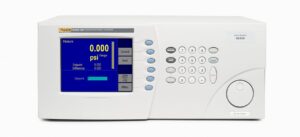
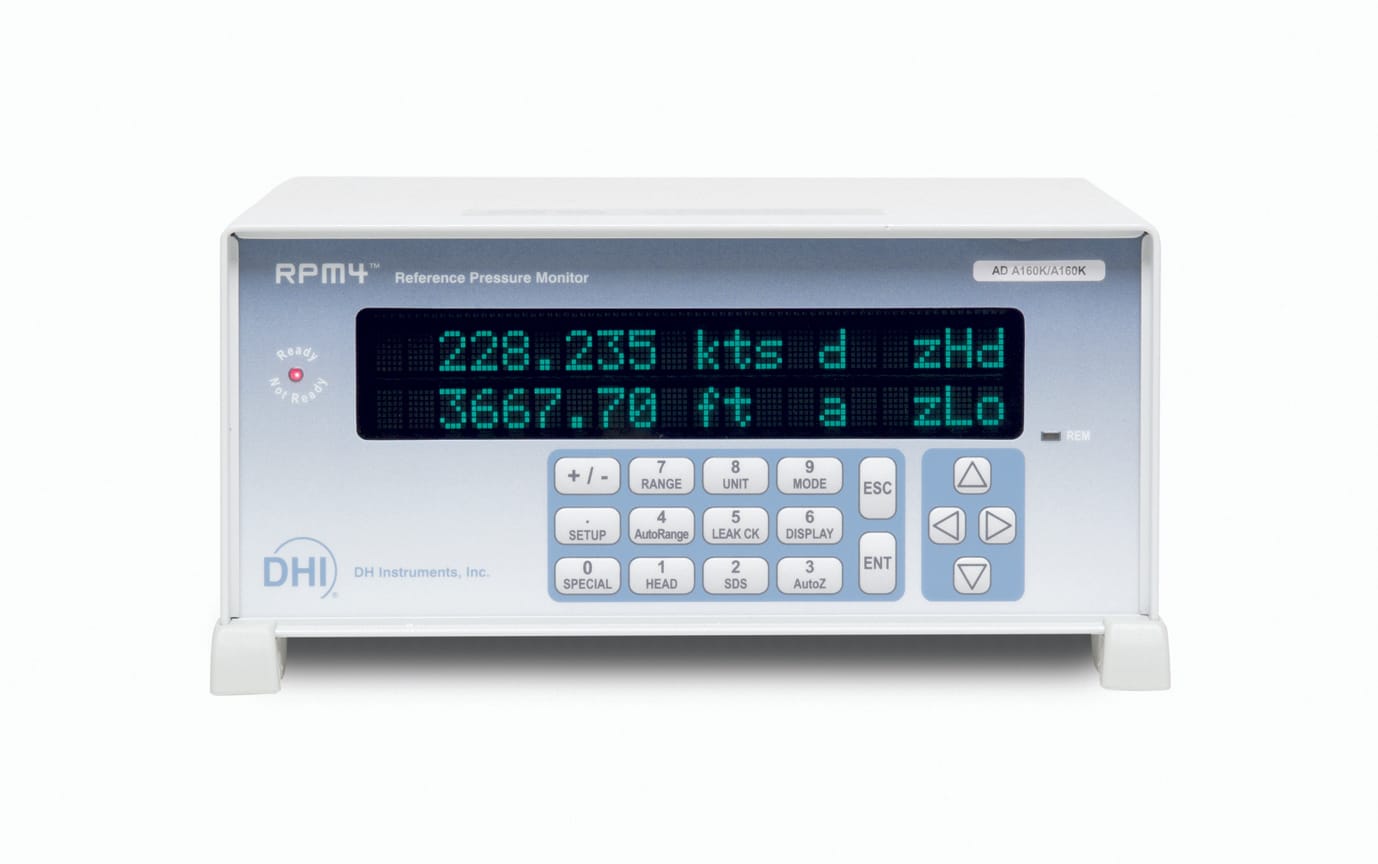
Fluke Calibration RPM4 AD is a precise reference pressure monitor specifically configured for air data calibration and high-performance measurement of pitot and static pressures. Based on Fluke Calibration’s RPM4 reference pressure monitor platform and its quartz reference pressure transducer technology, the RPM4 AD provides direct measurement and display of Pt, Ps and Qc, as well as calculated altitude and airspeed values.
Designed for aerospace and avionics calibration applications, the RPM4 AD can display altitude in feet or meters and airspeed in knots, mph, km/h and Mach. Conventional pressure units are also available, allowing the instrument to function as both a specialized air data reference and a high-performance pressure monitor.
Two configurations were offered for different aircraft applications: the RPM4 AD A160K/A160K for rotary-wing applications and the RPM4 AD A350K/A160K for fixed-wing applications. Depending on configuration, altitude ranges extend to 100,000 ft / 30,000 m and airspeed measurement extends to 1,100 knots / 2,040 km/h at sea level.
The RPM4 AD uses high-performance Q-RPT quartz reference pressure transducers for accurate measurement of static and total pressure. The instrument also includes Fluke Calibration’s Self Defense System (SDS™), which automatically isolates the sensitive Q-RPTs from the Ps and Pt test ports and vents them to atmosphere when necessary to protect the reference transducers against excessive pressure.
Automated rate measurement and leak testing functions simplify air data calibration procedures. RS232 and IEEE-488.2 communication interfaces enable integration into automated calibration systems.
The Fluke Calibration RPM4 AD is discontinued. Fluke Calibration identifies the 7750i Air Data Test Set as the replacement product. Nevertheless, existing RPM4 AD systems remain relevant in calibration laboratories where they continue to be used as high-performance air data reference pressure monitors.
At europascal, the Fluke Calibration RPM4 AD can be integrated into professional pressure and air data calibration environments. For professional calibration and metrological traceability, visit the europascal Calibration Service.
Your Benefits at a Glance
The Fluke Calibration RPM4 AD combines high-accuracy reference pressure measurement with dedicated air data functionality.
Key features include:
- Reference pressure monitor for air data calibration
- Dedicated air data configuration
- True Pt measurement
- True Ps measurement
- Qc differential pressure measurement
- Direct altitude indication
- Direct airspeed indication
- Altitude displayed in feet or meters
- Airspeed displayed in knots, mph, km/h or Mach
- Conventional pressure units
- Q-RPT quartz reference pressure transducers
- Transfer-standard-level measurement performance
- Resolution adjustable to 1 ppm
- Automated pressure rate measurement
- User-selectable rate measurement sample time
- Automated leak check
- Self Defense System SDS™
- Automatic Q-RPT overpressure protection
- Fixed-wing configuration available
- Rotary-wing configuration available
- RS232 communication
- IEEE-488.2 communication
- Suitable for automated calibration systems
- Compact laboratory design
- Optional 19-inch rack mounting
- Designed for professional aerospace calibration
- Clean, dry, non-corrosive gas as operating medium
Air Data Calibration
The Fluke Calibration RPM4 AD was developed specifically for professional air data calibration.
Air data systems determine important flight parameters from pressure measurements.
Two fundamental pressure quantities are:
Ps = Static Pressure
and
Pt = Total Pressure or Pitot Pressure.
From these pressure quantities, additional air data parameters can be determined.
One particularly important quantity is:
Qc = Pt − Ps
which represents the impact or differential pressure used for airspeed determination.
The RPM4 AD measures these pressure quantities with dedicated high-performance reference transducers.
Pt – Total Pressure
Pt represents total pressure measured by the pitot system.
It contains the static pressure component together with the pressure component caused by aircraft motion through the air.
Accurate Pt measurement is therefore essential when calibrating airspeed measurement systems.
The RPM4 AD provides a dedicated Pt connection and corresponding internal reference measurement.
Ps – Static Pressure
Ps represents static atmospheric pressure.
Static pressure is one of the fundamental quantities used to determine aircraft altitude.
As altitude increases, atmospheric pressure decreases.
By measuring static pressure accurately and applying the appropriate standard atmosphere relationship, the RPM4 AD can display the corresponding altitude directly.
Qc – Impact Pressure
The difference between total and static pressure is:
Qc = Pt − Ps
The RPM4 AD supports true Qc measurement using its internal Q-RPT configuration.
This differential pressure is fundamental to determining indicated airspeed.
The ability to work directly with Pt, Ps and Qc makes the RPM4 AD substantially different from a conventional reference pressure monitor.
Direct Altitude Display
The Fluke Calibration RPM4 AD converts pressure measurement into air data values and can directly display:
Altitude in feet
or
Altitude in meters.
This eliminates the need for the operator to manually convert static pressure into altitude during routine air data calibration.
Direct Airspeed Display
The RPM4 AD can also directly display airspeed.
Supported airspeed units include:
- knots
- mph
- km/h
- Mach
This makes the instrument convenient for calibration and testing of aircraft air data instruments.
Rotary-Wing Version
For rotary-wing applications, Fluke offered the:
RPM4 AD A160K/A160K.
This configuration uses a 160 kPa absolute Ps range and a 160 kPa absolute Pt range.
The resulting Qc range at sea level is:
60 kPa / 8.7 psi.
The specified altitude range is:
−13,000 ft to 66,000 ft
or:
−4,000 m to 20,000 m.
The specified sea-level airspeed range extends to:
550 knots
or approximately:
1,020 km/h.
This configuration is optimized for rotary-wing aircraft applications.
Fixed-Wing Version
For higher airspeed fixed-wing applications, Fluke offered the:
RPM4 AD A350K/A160K.
The static pressure channel uses a:
160 kPa absolute Q-RPT,
while the higher-range total pressure channel extends to:
350 kPa absolute.
The resulting Qc capability at sea level extends to:
250 kPa / 36 psi.
The altitude range extends to:
100,000 ft / 30,000 m.
The sea-level airspeed range extends to:
1,100 knots / approximately 2,040 km/h.
This makes the RPM4 AD A350K/A160K suitable for high-performance fixed-wing air data calibration.
Q-RPT Technology
The measurement performance of the Fluke Calibration RPM4 AD is based on Fluke Calibration’s:
Q-RPT Quartz Reference Pressure Transducer technology.
Q-RPTs are high-performance reference pressure transducers designed for precision pressure metrology.
They provide the stability, repeatability and resolution required for use as laboratory reference instruments and transfer standards.
High Measurement Performance
The RPM4 AD was designed to provide transfer-standard-level measurement performance.
Depending on the installed Q-RPT configuration and measurement mode, Fluke specifies uncertainties down to approximately:
±0.006% of reading
for selected operating conditions.
Other configurations have different reading-based and absolute minimum uncertainty specifications.
The applicable specification must therefore always be selected according to the exact RPM4 AD configuration and measurement mode.
Resolution to 1 ppm
The Fluke Calibration RPM4 AD provides measurement resolution:
to 1 ppm.
The displayed resolution is user adjustable.
This allows the instrument to be configured according to the required measurement application.
Parallel Measurement
The RPM4 AD A160K/A160K rotary-wing configuration contains two identical Q-RPT ranges.
This enables parallel measurement operation.
Comparing the two Q-RPTs can help identify possible transducer drift between calibrations.
This provides an additional level of confidence when the RPM4 AD is used as a high-performance transfer reference.
AutoZero
Q-RPT measurement performance is supported by Fluke Calibration’s AutoZero concept.
Depending on the operating mode, zeroing can be performed against zero pressure, another Q-RPT or an appropriate barometric reference.
Regular AutoZero operation contributes to maintaining the measurement performance of the RPM4 AD.
Self Defense System SDS™
The Fluke Calibration RPM4 AD incorporates the:
Self Defense System SDS™.
The Q-RPTs used for precision pressure measurement are sensitive reference devices.
The SDS protects these transducers against accidental excessive pressure.
When protection is required, the system isolates the Q-RPTs from the Pt and Ps test connections and vents the reference transducers to atmosphere.
Overpressure Protection
The SDS provides substantial protection against accidental overpressure.
Fluke specifies SDS protection up to:
10 MPa / 1,500 psi.
The normal operating limits of the individual Q-RPTs and the complete RPM4 AD system must nevertheless always be observed.
Automated Rate Measurement
The Fluke Calibration RPM4 AD includes automated pressure rate measurement.
The operator can define the required sample time.
This is useful when testing air data equipment under controlled pressure-change conditions.
Rate measurement can be important when evaluating the dynamic response of aviation pressure instruments.
Automated Leak Check
Another integrated function is:
automated leak checking.
Leakage can significantly influence air data calibration because even small leaks in the pneumatic system can cause pressure drift.
The automated leak test helps the operator evaluate system integrity before or during a calibration procedure.
Clean, Dry Gas Operation
The Fluke Calibration RPM4 AD is designed for:
clean, dry, non-corrosive gas.
Contamination of the pressure system should be avoided.
Oil, water and aggressive gases are not appropriate operating media for the standard air data configuration.
This is particularly important for maintaining the performance and reliability of the precision Q-RPTs.
Pressure Connections
The Pt and Ps test connections are:
AN-4 male, 37° flare.
The VENT and ATM connections use:
10-32 UNF.
These connections reflect the RPM4 AD’s specialization for aviation and air data applications.
RS232 Communication
The Fluke Calibration RPM4 AD provides two RS232 communication ports.
These interfaces allow communication with computers and compatible calibration systems.
This enables remote instrument operation and integration into automated procedures.
IEEE-488.2 Interface
In addition to RS232, the RPM4 AD supports:
IEEE-488.2 / GPIB.
GPIB remains widely used in professional calibration laboratories and automated measurement systems.
The combination of RS232 and IEEE-488.2 provides flexible integration with existing calibration equipment.
Automated Calibration Systems
The remote communication capabilities make the Fluke Calibration RPM4 AD suitable for automated air data calibration.
An external computer can be used to:
- Read pressure values
- Read air data values
- Configure measurement functions
- Initiate measurement sequences
- Perform leak checks
- Record calibration data
This can improve repeatability and efficiency in laboratories performing large numbers of air data calibrations.
Laboratory and Transfer Standard Applications
The RPM4 AD combines laboratory-level pressure measurement performance with a compact enclosure.
Typical applications include:
- Air data calibration laboratories
- Avionics maintenance facilities
- Aerospace manufacturing
- Aircraft maintenance
- Pitot-static instrument calibration
- Transfer standard applications
- Research and development
- Automated calibration systems
Compact Construction
Despite its dual-channel precision measurement system, the RPM4 AD has compact dimensions of approximately:
10 cm × 22.7 cm × 24 cm
and weighs approximately:
5 kg.
This makes the instrument suitable for both permanent laboratory installation and transport between calibration locations.
19-Inch Rack Installation
A rack mount kit was available for installation in a standard:
19-inch equipment rack.
This is useful for integrating the RPM4 AD into complete automated air data calibration systems.
Power Supply
The Fluke Calibration RPM4 AD operates from:
85 to 264 VAC, 50/60 Hz
with maximum consumption of approximately:
25 VA.
Operation from:
12 VDC
is also supported.
Operating Temperature
The specified normal operating temperature range is:
15°C to 35°C.
For optimum measurement performance after a cold start, Fluke recommends an appropriate stabilization period before precision measurements are performed.
Technical Highlights
| Feature | Fluke Calibration RPM4 AD |
|---|---|
| Product type | Air Data Reference Pressure Monitor |
| Measurement quantities | Pt, Ps, Qc |
| Air data outputs | Altitude and airspeed |
| Pressure technology | Q-RPT Quartz Reference Pressure Transducers |
| Rotary-wing model | RPM4 AD A160K/A160K |
| Fixed-wing model | RPM4 AD A350K/A160K |
| Ps range | Up to 160 kPa absolute |
| Pt range | Up to 350 kPa absolute |
| Qc range | Up to 250 kPa differential |
| Maximum altitude | 100,000 ft / 30,000 m |
| Maximum airspeed | 1,100 knots / 2,040 km/h |
| Resolution | To 1 ppm, adjustable |
| Protection | SDS™ Self Defense System |
| SDS protection | Up to 10 MPa / 1,500 psi |
| Operating medium | Clean, dry, non-corrosive gas |
| Pt / Ps connections | AN-4 male, 37° flare |
| Communication | RS232 and IEEE-488.2 |
| Operating temperature | 15°C to 35°C |
| Weight | Approx. 5 kg |
| Dimensions | Approx. 10 × 22.7 × 24 cm |
| Product status | Discontinued |
| Fluke successor | 7750i Air Data Test Set |
RPM4 AD vs. Standard RPM4
The Fluke Calibration RPM4 AD should not be confused with the standard RPM4 Reference Pressure Monitor.
The standard RPM4 is a general-purpose precision reference pressure monitor available with numerous Q-RPT pressure ranges.
The RPM4 AD is a specialized configuration for:
air data calibration.
It is optimized for simultaneous static and total pressure measurement and provides direct Pt, Ps and Qc functionality together with altitude and airspeed calculations.
For aviation applications, these dedicated air data functions make the RPM4 AD substantially more convenient than a conventional pressure monitor.
Rotary-Wing vs. Fixed-Wing Configuration
The correct Fluke Calibration RPM4 AD configuration depends on the application.
The:
RPM4 AD A160K/A160K
configuration is intended primarily for rotary-wing applications and covers airspeed to 550 knots and altitude to 66,000 ft.
The:
RPM4 AD A350K/A160K
configuration is intended for fixed-wing applications and extends the airspeed capability to 1,100 knots and altitude to 100,000 ft.
The fixed-wing configuration therefore provides the larger Pt and Qc measurement ranges required for higher aircraft speeds.
Typical Applications
The Fluke Calibration RPM4 AD is suitable for:
- Air data calibration
- Pitot-static calibration
- Altimeter calibration
- Airspeed indicator calibration
- Aircraft instrument testing
- Avionics calibration
- Aviation pressure measurement
- Pt measurement
- Ps measurement
- Qc differential pressure measurement
- Altitude measurement
- Airspeed measurement
- Fixed-wing aircraft applications
- Rotary-wing aircraft applications
- Aerospace manufacturing
- Aircraft maintenance
- Calibration laboratories
- Transfer standard applications
- Automated pressure calibration
- Research and development
Discontinued Product
The Fluke Calibration RPM4 AD is discontinued.
Fluke Calibration identifies the:
Fluke Calibration 7750i Air Data Test Set
as its successor.
For existing RPM4 AD systems, the original documentation and operating instructions remain important for maintenance and continued use.
For new air data calibration systems, the current Fluke Calibration 7750i platform should be considered.
Why Choose the Fluke Calibration RPM4 AD?
The Fluke Calibration RPM4 AD was developed specifically for high-performance air data pressure measurement rather than general-purpose pressure indication.
Its dedicated Pt, Ps and Qc functionality enables direct measurement of the pressure quantities required for pitot-static and air data calibration.
Altitude and airspeed can be displayed directly in aviation-specific units, reducing the need for external pressure-to-air-data conversions.
High-performance Q-RPT quartz reference pressure transducers provide transfer-standard-level measurement performance, while the integrated SDS™ Self Defense System protects the sensitive reference sensors against accidental overpressure.
Separate rotary-wing and fixed-wing configurations provide measurement ranges appropriate for different aircraft applications.
Automated rate measurement and leak checking simplify calibration procedures, while RS232 and IEEE-488.2 communication interfaces support integration into automated laboratory systems.
Although the RPM4 AD has been discontinued, existing instruments remain valuable high-performance air data reference pressure monitors. For new installations, Fluke Calibration identifies the 7750i Air Data Test Set as the successor.
At europascal, we support professional pressure measurement and calibration solutions for laboratory, aerospace and industrial applications.
For professional calibration and metrological traceability, visit the europascal Calibration Service.
Further products from Fluke Calibration are available from europascal.
Manufacturer information about the Fluke Calibration RPM4 AD and current air data calibration solutions is available on the official Fluke Calibration website.